



Mount Everest Facts and Information

-
 Sobit Bhandari
 -
20 December, 2024
-
21 mins read
-
2762 Views
-
0 Comments


Wrapped in the whispers of ancient winds, Mount Everest rises like a timeless dream carved in snow and silence. Mount Everest is renowned as the roof of the earth, and the world’s highest mountain, towering at an astonishing 8,848.86 meters (29,031.7 feet) above sea level. As a part of the great Himalayan range, Everest has become a global symbol of exploration and endeavor, attracting hundreds of climbers each year.
Known as Sagarmatha in Nepal and Chomolungma in Tibet, Mount Everest is more than just the tallest mountain on Earth. For the people living around it, the mountain is a cultural and spiritual symbol, respected and admired for its beauty, power, and deep connection to local traditions.
Everest holds great significance in geography as it is the summit of the terrestrial surface created as a result of the collision between the Indian plate and the Eurasian tectonic plate. It has great significance as one of the adventure tourism destinations, as many people come to its base camp for treks. For the world of global mountaineering, Mount Everest holds great significance as the summit for climbers from around the world, which tests endurance, skill, and human determination. These Mount Everest facts and information highlight its height, location, challenging climate, rich Sherpa heritage, and its significance as a top destination for global mountaineers and explorers.
Where is Mount Everest located?
Mount Everest, also known as Sagarmatha, is located in the Mahalangur range, straddling the border between Nepal and Tibet. The exact coordinates of Mount Everest are 27.9881° N latitude and 86.9250° E longitude. As part of the great Himalayas, which stretch 2,500 km through Nepal, India, Pakistan, Tibet, and China, Everest stands as a symbol of natural grandeur and adventure.
The south side of Mount Everest lies in Nepal, while the north side is in Tibet. In Nepal, Everest is situated within Sagarmatha National Park, a UNESCO World Heritage site in the Solukhumbu district. This region is renowned for its breathtaking landscapes, diverse wildlife, glaciers, and rich Sherpa culture.
On the North side of Tibet, the mountain is part of the Qomolangma National Nature Preserve, an area dedicated to protecting its unique high-altitude ecosystem.
With its strategic position in the Everest Himalayas, the mountain has become a key destination for climbers, trekkers, and researchers seeking to explore one of the most extraordinary places on Earth.
How high is Mount Everest?
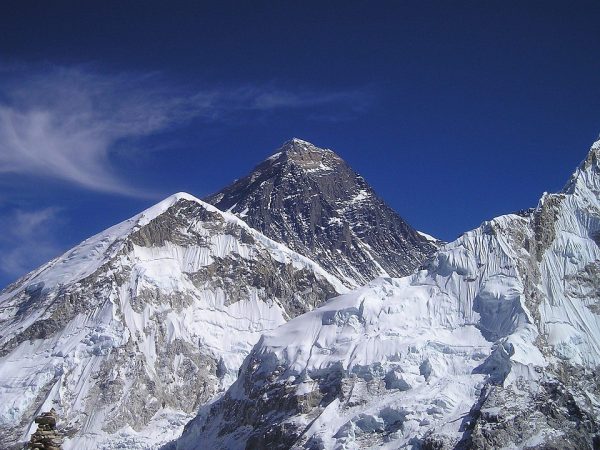
Mount Everest is the highest mountain in the world, standing at an official height of 8,848.86 meters (29,031.7 feet). This updated measurement was announced in 2020 after a joint survey by Nepal and China, providing the most accurate figure to date.
The height of Everest has been measured several times over the years, starting with the British survey in the 19th century. Early measurements relied on triangulation and basic surveying techniques, while modern technology uses GPS and satellite data to achieve precise results.
Everest’s height is not fixed and can change slightly over time due to natural geological processes. The collision of the Indian and Eurasian tectonic plates continues to push the Himalayas upward, while earthquakes and shifting glaciers can cause minor adjustments in its elevation.
How Old is Mount Everest? The Geological History and Formation of the World’s Highest Peak
Mount Everest, the world’s tallest peak, is estimated to be 50 to 60 million years old, making it relatively young by geological standards. As a part of the majestic Himalayan range, Everest shares its origin story with these towering peaks, which were formed through significant geological processes.
The current official elevation of Everest, accepted by both China and Nepal, was established by a 1955 Indian survey and confirmed by a 1975 Chinese survey. However, the peak’s journey to fame started much earlier. Originally named “Gamma” and later “Peak b” in 1847, it was suspected that this peak might surpass Kanchenjunga, the previously considered highest mountain in the world.
Through numerous surveys and measurements over the next few years, the great height of “Peak b” was confirmed, leading to its renaming as “Peak XV.” Finally, in 1865, the Royal Geographical Society bestowed upon it the official English name of Mount Everest.
In addition to its official name, Mount Everest has been known by several other names throughout history. In the late 19th century, many European cartographers mistakenly believed the mountain’s native name to be Gaurishankar, a mountain located between Kathmandu and Everest. In Nepal, Mount Everest is also known as Sagarmatha, a Sanskrit name meaning “Peak of Heaven” or “Goddess of the Sky.” The Tibetan name for Everest is Qomolangma or Chomolungma, meaning “Holy Mother.”
Formation of the Himalayas
The formation of the Himalayas began approximately 40-50 million years ago with the collision of the Indian tectonic plate with the Eurasian continent. This tectonic activity, characterized by the northward movement of the Indian plate at a rate of 15 cm per year, resulted in the uplift of lighter rocks from ancient seabeds, creating the Himalayan range. A fascinating fact that illustrates this process is that the summit of Mount Everest is composed of marine limestone, indicating its underwater origins.
Ongoing Geological Processes
The geological forces that formed Everest continue to shape it today. The summit of Everest rises about a quarter of an inch higher each year due to the ongoing movement of tectonic plates. This continuous uplift ensures that the highest peak on Earth continues to rise, ever so slightly, year by year.
The Significance of Everest’s Geology
Understanding the geological history and formation of Mount Everest not only highlights its grandeur but also underscores the dynamic processes that continue to shape our planet. Everest’s relatively young age and its ongoing elevation are a testament to the powerful natural forces at work beneath the Earth’s surface.
By delving into the geological story of Mount Everest, we gain a deeper appreciation for this iconic mountain and the remarkable natural phenomena that continue to influence its towering presence.
The Evolution of Mount Everest’s Name and Height: A Detailed Survey History
Mount Everest was confirmed as the world’s highest mountain, replacing Kanchenjunga, which was previously considered the highest peak. Here’s a detailed look at how Everest’s name and height have evolved through various surveys:
1. 19th Century Survey
The British began the Great Trigonometric Survey of India in 1802 to determine the location, heights, and names of the world’s highest mountains. Although incomplete initially, the survey resumed in 1847, focusing on the Himalayan peaks. The British Surveyor General of India, Andrew Waugh, conducted detailed measurements from the Sawajpore station. He and his subordinate, John Armstrong, identified a peak they called “peak ‘b’.”
In 1849, Waugh sent James Nicolson to measure peak ‘b’. Nicolson’s raw data indicated an average height of 9,200 meters (30,200 feet), suggesting it was higher than Kanchenjunga. This peak was then referred to as Peak XV. In 1852, an Indian mathematician and surveyor from Bengal identified Peak XV as the world’s highest peak using trigonometric calculations based on Nicolson’s measurements. The calculations were repeatedly verified, and the official announcement was made later.
2. 20th Century Survey
The height of 8,848 meters (29,029 feet) was officially approved by Nepal and China. The Chinese Academy of Sciences and the State Bureau of Surveying and Mapping announced Everest’s elevation as 8,844.43 meters (29,017.16 feet) with an accuracy of ±0.21 meters (8.3 inches), claiming it as the most accurate measurement. The team also measured a snow depth of 3.5 meters (11 feet), aligning with a net elevation of 8,848 meters.
However, a debate arose between China and Nepal over whether to use the rock height (8,844 meters) or the snow height (8,848 meters). In 2010, both countries agreed to recognize Everest’s height as 8,848 meters, with Nepal acknowledging China’s rock height claim.
3. 21st Century Survey
After years of calculations from the Great Trigonometric Survey, Andrew Waugh announced in 1856 that Everest (Peak XV) was 8,840 meters (29,002 feet). In 1865, Everest received its official English name. The height of 8,848 meters was first determined by the Indian survey in 1955 using theodolites and reaffirmed by a Chinese measurement in 1975, which measured the snow cap, not the rock head.
In 1999, an American Everest Expedition, led by Bradford Washburn, used GPS to secure the highest bedrock measurement. This determined a rock head elevation of 8,850 meters (29,035 feet) with a snow elevation 1 meter higher. Under Washburn’s direction in the late 1980s, a more accurate topographic map of the Everest region was created using extensive aerial photography.
Understanding the evolution of Mount Everest’s name and height offers a fascinating glimpse into the history and precision of mountain surveying, reflecting the dedication and advancements in geographic science over the centuries. These are some of the most important Mount Everest facts and information for anyone interested in the world’s tallest mountain.
Geological Composition of Mount Everest: An In-Depth Look
Mount Everest, the world’s highest peak, is a geological marvel composed of distinct rock formations, each separated by low-angle faults known as detachments. These formations have been thrust southward over each other, creating the complex structure of Everest as we know it today. From the summit to the base, the three primary rock units of Everest are the Qomolangma Formation, the North Col Formation, and the Rongbuk Formation.
Qomolangma Formation: This formation extends from the summit down to the top of the Yellow Band, approximately 8,600 meters (28,200 feet) above sea level. Also known as the Jolmo Lungama Formation, it consists of greyish to dark grey or white Ordovician limestone, characterized by parallel layering and embedding. The formation also contains interlayered subordinate beds of recrystallized dolomite with argillaceous laminae and siltstone. High-angle faults disrupt the Qomolangma Formation, terminating at the low-angle normal fault called the Qomolangma Detachment.
North Col Formation: Situated between 7,000 meters (23,000 feet) and 8,600 meters (28,200 feet), the North Col Formation constitutes the bulk of Everest. The Yellow Band, which forms the upper part of this formation, lies between 8,200 meters (26,900 feet) and 8,600 meters (28,200 feet). This band consists of Middle Cambrian diopside-epidote-bearing marble and is distinguished by its yellowish-brown and muscovite-biotite phyllite or semischist composition.
Rongbuk Formation: Below 7,000 meters (23,000 feet), the Rongbuk Formation forms the base of Mount Everest. It comprises sillimanite-K-feldspar grade schist and gneiss, intruded by various sills and barriers of leucogranite. This formation represents the deeper layers of Everest’s geological structure.
Everest’s rocks are primarily sedimentary and metamorphic, faulted southward across continental crust formed by Archean granulites of the Indian plate during the Cenozoic collision of India with Asia. Recent interpretations suggest that the Qomolangma and North Col Formations consist of marine sediments, which accumulated within the continental shelf of the northern passive continental margin of India before its collision with Asia.
Understanding the geological makeup of Mount Everest not only provides insights into its formation but also enhances our appreciation of this iconic natural wonder.
Climate and Glacial Activity on Mount Everest
Mount Everest experiences a polar climate (Köppen EF) with average temperatures well below freezing throughout the year. The average temperature in July is around -18 degrees Celsius, while in January, it drops to approximately -36 degrees Celsius. These extreme temperatures contribute to the extensive glacial coverage on Everest’s slopes.
1. Glacial Coverage
The slopes of Everest are covered by glaciers that extend to its base. The prominent glaciers include:
- Kangshung Glacier: Consuming the East, Central, and West slopes.
- Rongbuk and Pumori Glaciers: Covering the north and northwest regions.
- Khumbu Glacier: Extending to the west and south.
The Western Cwm, an embedded valley of ice between Everest and the Lhotse-Nuptse Ridge to the south, is filled by the glacier bed, further contributing to the mountain’s glacial landscape.
2. Impact of Glacial Activity
Glacial activity has been the primary force behind the significant and ongoing erosion of Everest and other mountains in the region. The glaciers continuously reshape the mountain’s landscape, creating deep valleys and rugged terrains.
3. Unpredictable Himalayan Climate
The climate and weather in the Himalayas are notoriously unpredictable. Rapid changes in weather conditions can occur, posing significant challenges for climbers and researchers. This unpredictability, combined with the extreme cold and glacial presence, makes Mount Everest one of the most formidable and fascinating natural wonders in the world.
Understanding the climate and glacial dynamics of Mount Everest is crucial for anyone planning an expedition or study in the region. These factors not only define the mountain’s unique environment but also influence the strategies and preparations required for a successful and safe journey.
Flora and Fauna of Mount Everest: A Diverse Ecosystem
Mount Everest lies in the Sagarmatha National Park in Nepal. This region remains a protected one and has a diverse range of flora and fauna. The lower mountain peaks are covered with alpine forests of rhododendrons, firs, and juniper trees. The upper region provides space for hardy mosses and small bushes that can tolerate the cold and wind.
Indigenous Flora on Mount Everest
Mount Everest, known for its extreme conditions, has very little indigenous flora. However, the Everest region is teeming with diverse plant life. Notably:
- Moss: Grows at an astonishing elevation of 6,480 meters (21,260 feet), potentially the highest elevation plant species.
- Arenaria: An alpine cushion plant found below 5,500 meters (18,000 feet).
Unique Fauna on Mount Everest
The fauna on Mount Everest, while rare, includes several unique species:
- Euphorias omnisuperstes: A minute black jumping spider found at altitudes as high as 6,700 meters (22,000 feet). This spider might be the highest confirmed non-microscopic permanent resident on Earth, hiding in crevices and feeding on frozen insects.
- Microscopic Life: Likely present at even higher altitudes.
Larger Animals in the Everest Region
Several larger animals are adapted to Everest’s harsh environment:
- Yaks: Frequently used to haul gear for Everest climbs. They can carry 100 kg (220 pounds) and have thick fur and large lungs, perfect for high altitudes.
- Himalayan Tahr: Sometimes preyed upon by the snow leopard.
- Himalayan Black Bear: Found up to about 4,300 meters (14,000 feet).
- Red Pandas: Present in the region.
Birds of Mount Everest
Birdlife in the Everest region includes:
- Bar-Headed Goose: Seen flying at higher altitudes, even above Mount Everest’s summit.
- Choughs: Including the yellow-billed chough, observed as high as 7,900 meters (26,000 feet).
- South Col Sightings: Choughs have been found as high as the South Col at 7,920 meters (25,980 feet).
Expanding Vegetation
Recent studies based on satellite data from 1993 to 2018 show that vegetation is expanding in the Everest region. Researchers have discovered plants in areas previously deemed barren.
Understanding the flora and fauna of Mount Everest not only highlights the mountain’s ecological diversity but also underscores the adaptability of life in extreme conditions. This knowledge enriches the experience of those who explore this majestic peak and its surroundings.
The Allure of Mount Everest: Reaching the World’s Highest Summit
Mount Everest is an awe-inspiring natural wonder, renowned for its breathtaking beauty and status as the world’s highest peak. Each year, thousands of adventurers from around the globe are drawn to its majestic slopes, aiming to achieve the remarkable feat of reaching its summit.
- The Ultimate Climbing Challenge
Reaching the summit of Mount Everest is a goal pursued by many but achieved by only the brave and bold. The climb requires not only physical endurance but also mental resilience. Climbers face extreme conditions, including the need for supplemental oxygen due to the thin air at high altitudes and the necessity for extremely warm clothing to withstand the harsh temperatures.
- Stunning Panoramic Views
The ascent offers unparalleled views of the surrounding Himalayan range, with hundreds of majestic peaks and panoramic vistas that are simply breathtaking. These magnificent views are a significant draw for climbers and trekkers alike, providing a once-in-a-lifetime experience of natural beauty and grandeur.
- A Global Attraction
Mount Everest’s allure extends beyond climbers. Every year, thousands of tourists visit the region to witness its splendor, trek to its base camp, or simply bask in the awe of standing in the shadow of the world’s highest mountain.
- A Symbol of Achievement
Conquering Mount Everest is not just about reaching the summit; it symbolizes human perseverance, courage, and the relentless pursuit of dreams. Being the highest point on Earth, it represents a monumental achievement and an enduring inspiration for explorers and nature enthusiasts worldwide.
In conclusion, Mount Everest’s stunning beauty, combined with the challenge of its ascent and the awe-inspiring views it offers, continues to captivate and inspire people from all corners of the globe. Whether you aim to climb it or simply wish to experience its grandeur, Mount Everest remains a pinnacle of natural wonder and human ambition.
The History and Milestones of Climbing Mount Everest
Mount Everest, the highest mountain in the world, has captivated the hearts of trekkers and climbers for decades. While its allure draws thousands of adventurers each year, the mountain’s reputation surged after the first successful summit in 1953. Here’s a look at the significant milestones in Everest’s climbing history.
1. Early Attempts and the First Successful Summit
Before 1953, Mount Everest was an elusive prize for many mountaineers. Despite numerous attempts by professional climbers and large national expeditions, only about 200 people had summited by 1987. The breakthrough came when New Zealander Sir Edmund Hillary and Nepali Sherpa Tenzing Norgay became the first known climbers to reach the summit on May 29, 1953.
2. Pioneering Climbers
Several notable climbers paved the way for Hillary and Norgay’s success. George Mallory, who discovered the north route to the summit in 1921, and George Finch, who reached an altitude of over 8,230 meters (27,000 feet) using oxygen for the first time in 1922, made significant contributions to Everest exploration.
3. Notable Ascents and Records
- First Summit from the North Side: Tibetan Nawang Gombu and Chinese mountaineers Wang Fu-Zhou and Chu Yin-Hau made the first confirmed summit from Everest’s north side on May 25, 1960.
- First Female Climber: Japanese mountaineer Junko Tabei became the first woman to reach the summit in 1975.
- Without Supplemental Oxygen: Reinhold Messner and Peter Habeler were the first to summit without supplemental oxygen in 1978.
- First Blind Climber: Erik Weihenmayer became the first blind person to reach the summit in 2001.
- Oldest Climber: Min Bahadur Sherchan set the record as the oldest person to summit at the age of 76.
- Youngest Climber: Jordan Romero became the youngest person to reach the summit at the age of 13.
- First Ski Descent: Yuichiro Miura was the first person to ski down Everest in the 1970s.
4. The Commercial Climbing Era
The 1990s marked the beginning of the commercial climbing era, making Everest more accessible to non-professional climbers. This shift has significantly increased the number of successful summits, with more climbers from around the world achieving their dream of standing atop the world’s highest peak.
Sherpa Culture and its Role on Everest
The Sherpa are a people who are indigenous to the high Himalayan ranges in Nepal, specifically in the Everest range. The Sherpa are known for their incredible warmth in receiving guests into their communities, their strong community values, and the rich religious practices that form the foundation of their culture. This culture is closely connected to the Buddhist religion, nature, and the mountains that surround their villages.
Because they have natural adaptations to living in such high places, Sherpas are recognized worldwide for their exceptional mountaineering skills, strength, and endurance. These abilities make them essential to the success of almost all expeditions to Mount Everest.
On the mountain, the Sherpas of Everest play crucial roles like
- Guiding climbers safely through difficult sections
- Fixing ropes and ladders along the route
- Carrying loads and supplies between camps
- Supporting rescue and emergency operations when climbers are in danger
Their courage, experience, and dedication have made Sherpas the true backbone of Everest expeditions, earning them respect from climbers around the world. This makes Sherpa culture an important part of Everest’s history and identity.
Everest Climbing Routes
Mount Everest expedition has multiple routes through which it can be ascended, but very few are frequently used. Every route has its difficulties, terrain, as well as ease of accessibility. The most taken routes to the top of Mount Everest are the South Col Route in Nepal and the North Ridge Route in Tibet, apart from a couple of very challenging ones. These Everest climbing routes provide a distinct means of reaching the top of the earth.
1. South Col Route (Nepal)
The South Col route is the most popular route, which has been termed the standard route to climb Everest. It begins in Nepal and passes through some crucial sections: the Khumbu Icefall is considered one of the most dangerous parts of the journey. The climbers advance through numerous high camps, crossing the Western Cwm, and arrive at the South Col to attempt the summit. The steep rock face just below the summit-the famous Hillary Step-is negotiated close to the top. This is the most popular route because of better support, logistics, and rescue options.
2. North Ridge Route (Tibet)
The North Ridge route starts from Tibet and is known for its challenging, windy terrain. Climbers must navigate long, exposed ridges and pass through high camps positioned on steep slopes. While this route is technically demanding and more affected by strong winds, it is favored by climbers who prefer quieter paths and fewer crowds. Despite its difficulty, it offers stunning scenery and a more direct approach to the summit.
3. Other Rare and Technical Routes
Besides the main routes, Everest also has several rare and highly technical routes, such as the West Ridge and the Kangshung Face. These paths are extremely difficult andare attempted only by experienced mountaineers due to their complex terrain, unpredictable weather, and limited rescue access. They offer a more adventurous and challenging climbing experience for elite climbers.
Danger and Death Zone of Everest
One of the most challenging aspects of climbing Mount Everest is the “Death Zone,” which is areas at an altitude of 8,000 meters (26,247 feet) or higher. At this altitude, the concentration of oxygen is so low that it is insufficient for a human body to survive. Every move a mountaineer makes to reach the top is a move made at the cost of their life.
The main causes of deaths that have occurred on the Everest include altitude sickness, falls, avalanches, and freezing temperatures. Certain sections in the mountain can be very risky, such as the Khumbu Icefall, whose terrain consists of moving ice and deep crevasses. Several weather conditions, particularly the possibility of unexpected storms and high winds, add another major threat to the success of the mission.
Understanding these Everest dangers and key death zone facts is essential for climbers and trekkers, highlighting why climbing Everest requires skill, experience, and respect for the mountain’s extreme conditions.
Everest Today
Today, Mount Everest remains a symbol of human endeavor and exploration. Its challenging climb continues to attract both seasoned climbers and adventure enthusiasts. As new records are set and more climbers take on the challenge, Everest’s legacy as the ultimate mountaineering goal endures.
For those drawn to the allure of Everest, the mountain represents not just a physical challenge but a testament to the spirit of adventure and the enduring human desire to conquer the unknown.
FAQs of Mount Everest Facts and Information
1. How hard is it to climb Mount Everest?
Climbing Mount Everest is extremely challenging and requires excellent physical fitness, high-altitude experience, and proper preparation. Climbers face harsh weather, low oxygen, treacherous terrain, and the risk of altitude sickness. Even with guides and support, reaching the summit is physically and mentally demanding.
2. What is the success rate?
The overall success rate for reaching the summit of Everest varies by season and experience level, but is roughly 30-40% for first-time climbers. Experienced climbers with proper preparation have higher success, while risks like weather and health can prevent summits even for skilled mountaineers.
3. How much does it cost to climb?
The cost of climbing Everest depends on the type of expedition:
- Standard guided expedition: $40,000-$60,000 per person
- Luxury expedition: $60,000-$100,000+
Costs cover permits, guides, Sherpa support, equipment, oxygen, and logistics.
4. How many people climb every year?
Each climbing season, approximately 600-800 people attempt to summit Everest, with more trekking to Everest Base Camp. Crowding is common, especially in May during the pre-monsoon season.
5. Is Everest visible from Kathmandu?
Yes, Mount Everest can be seen from Kathmandu on clear days, but visibility is limited due to distance and haze. Most travelers prefer viewpoints like Nagarkot, Dhulikhel, or scenic flights to see Everest more clearly.
6. Why do people leave bodies on Everest?
Due to the extreme conditions in the Death Zone, such as low oxygen, freezing temperatures, and difficult terrain, recovering bodies is often too dangerous or impossible. Many climbers who die remain on the mountain, which has earned Everest nicknames like the “world’s highest cemetery.”
7. Can anyone climb Mount Everest?
Climbing Everest requires extensive preparation, physical fitness, and mountaineering experience. While guided expeditions are available, it is still a very challenging and dangerous adventure, not suitable for beginners without training.
Comments (0)
Write a comment- Where is Mount Everest located?
- How high is Mount Everest?
- How Old is Mount Everest? The Geological History and Formation of the World’s Highest Peak
- The Evolution of Mount Everest’s Name and Height: A Detailed Survey History
- Geological Composition of Mount Everest: An In-Depth Look
- Climate and Glacial Activity on Mount Everest
- Flora and Fauna of Mount Everest: A Diverse Ecosystem
- The Allure of Mount Everest: Reaching the World’s Highest Summit
- The History and Milestones of Climbing Mount Everest
- Sherpa Culture and its Role on Everest
- Everest Climbing Routes
- Danger and Death Zone of Everest
- Everest Today
- FAQs of Mount Everest Facts and Information
Read the latest Blogs & Insights
Explore our collection of articles and insights to gain in-depth travel knowledge, expert advice, and stay updated on the latest trends and tips.
View All Articles
Top 10 Best Treks in the World
30 Apr. 2026



No comments yet.