


Prayer Wheels
- Bold Himalaya
- 17 September, 2026
- 13 mins read
- 45 Views
- 0 Comments
While walking through the mountain trails of the Himalayas, you often see cylindrical objects placed along paths, near monasteries and sacred sites. These are prayer wheels, an important part of Himalayan Buddhist culture. They don’t make noise or demand attention, but their presence feels deeply meaningful in the stillness of the mountains.
You will notice them across regions like Nepal, Tibet, and Bhutan, especially along trekking routes where daily life and spirituality blend naturally. For people living in these regions, prayer wheels are part of everyday spiritual life. Turning them is believed to spread positive prayers and blessings. To visitors, they may look simple, but they carry deep religious meaning and are a quiet but constant presence in the mountain landscape.
In the silence of high-altitude landscapes, these slowly turning cylinders remind visitors that spirituality here is not loud or distant. It is constant, gentle, and always in motion, just like the wheels themselves.
Quick Information Table
| Detail | Information |
| Object Name | Prayer Wheel |
| Religion | Buddhism |
| Main Regions | Tibet, Nepal, Bhutan, Mongolia |
| Primary Purpose | Merit, Blessings, Practice |
| Common Materials | Metal, Wood, Leather, Stone |
| Associated Mantra | Om Mani Padme Hum |
| Symbolic Meaning | Compassion, Wisdom, Liberation, Dharma |
What are Prayer Wheels?
Prayer wheels are simple cylindrical objects used in Himalayan Buddhist traditions as a way of expressing prayer through movement instead of spoken words. At first glance, they may look like decorative metal or wooden tubes, but they hold deep spiritual meaning.

The spinning begins where belief takes form, an object shaped by ancient thought. This device, known as a prayer wheel, comes from the Dharmachakra, a symbol of how wisdom moves when it is taught. Instead of stillness, motion becomes devotion. Each turn matters not because it impresses, but because it repeats what is meaningful.
Spinning gently on an upright rod, a prayer wheel holds holy writings sealed within its round body. With movement powered by human hands, flowing streams, gusts of air, or heat from flames, the drum completes full turns. Each circle it makes is believed to count just like spoken chants. Inside rests folded scripture, which is silently released through motion rather than voice.
Prayer wheels come in different forms. Some are small handheld wheels that people turn while walking or praying. Others are large fixed wheels mounted in monastery walls that devotees spin as they walk past. In some places, you will also find wind-powered wheels turning on rooftops or hills, and water-powered wheels that rotate with flowing streams. In modern monasteries, a few are even powered electrically, but the purpose remains the same.
Origins and History of Prayer Wheels
The exact origin of prayer wheels is not known. However, Tibetan Buddhist traditions say that the idea was introduced by Nagarjuna, a philosopher in Mahayana Buddhism who lived around the 200s CE. Over time, the practice was passed down through generations of scholars before becoming an important part of Tibetan Buddhist culture.
Prayer wheels became part of daily Buddhist practice as Buddhism spread across Tibet between the 7th and 12th centuries. As monasteries grew and Buddhist teachings reached more communities, prayer wheels became increasingly common. Pilgrims spun them along sacred paths, and local people used them as part of their regular spiritual practice throughout the Himalayan highlands.
One reason prayer wheels became so popular is that anyone can use them. Unlike some religious practices that require reading, special training, or years of study, spinning a prayer wheel is simple and accessible. Children, elders, pilgrims, travelers, and local villagers can all take part in this act of devotion. A gentle turn of the wheel is believed to carry prayers and positive intentions. Because it is easy for everyone to participate, the practice spread widely across the Himalayan region and became an important part of Buddhist life for generations.
Prayer wheels evolved in both size and design. Early versions were often small and handheld, allowing practitioners to carry them during daily activities or pilgrimages. As monasteries grew and religious communities expanded, larger wheels were built into temple walls, courtyards, and sacred pathways. Later, water-powered and wind-powered wheels appeared, enabling prayers to continue turning continuously through the forces of nature.
Today, prayer wheels remain a living tradition, connecting modern practitioners with centuries of Himalayan Buddhist history while preserving a practice that has endured across generations.
Spiritual Meaning and Symbolism
Spinning the cylinder follows an old and meaningful rhythm. The movement reflects the time when Buddhist teachings first began to spread after Sarnath, reaching more people through simple and accessible ways. Each turn connects to a quiet flow of teachings shaped by wisdom passed down over time. The meaning is carried in every part of the wheel, and the act of spinning becomes a way to remember and reflect on those teachings.
Spinning the wheel activates the hidden scroll inside it, which is covered with repeated lines of Om Mani Padme Hum. With each turn, tradition says the words are released into the world, carried by movement instead of spoken voice. Merit is believed to build not through chanting, but through motion, one complete rotation at a time. Blessings are thought to spread quietly, reaching everything nearby without noise or attention. Even though the act is silent, its meaning is clear to those who understand it. Every full turn is considered complete and meaningful; no more, no less.
At the heart of Buddhism is the idea of merit, which is gained through good actions and positive behavior. Spinning a prayer wheel is believed to create merit and help people progress on their spiritual path. It also encourages kindness and compassion toward others. In this way, the practice supports both personal growth and care for all living beings.
Turning a prayer wheel can help calm the mind and improve focus. The gentle and repeated motion brings attention to the present moment. Many people spin prayer wheels while walking around temples, monasteries, or sacred sites. For some, this moving practice feels as peaceful as meditation. With each step and each turn of the wheel, the mind becomes quieter and more centered.
How do prayer wheels work?
A prayer wheel works through a simple but meaningful action – spinning. Inside every prayer wheel is a scroll containing sacred mantras. Although the wheel may look simple from the outside, the scroll inside can hold thousands or even millions of repetitions of the mantra Om Mani Padme Hum. In the past, these mantras were written by hand, but today they are often printed. The arrangement of the mantras follows traditional patterns and is carefully prepared. What appears to be a small object carries deep spiritual meaning.

According to Buddhist tradition, turning a prayer wheel sends the blessings of the mantras into the world, much like reciting them aloud. The movement is believed to spread positive intentions, compassion, and goodwill.
Prayer wheels are always turned clockwise, following an important Buddhist tradition. This direction reflects the sun’s movement across the sky and aligns with the way Tibetan mantras are traditionally read and written. Each turn follows a practice passed down for generations.
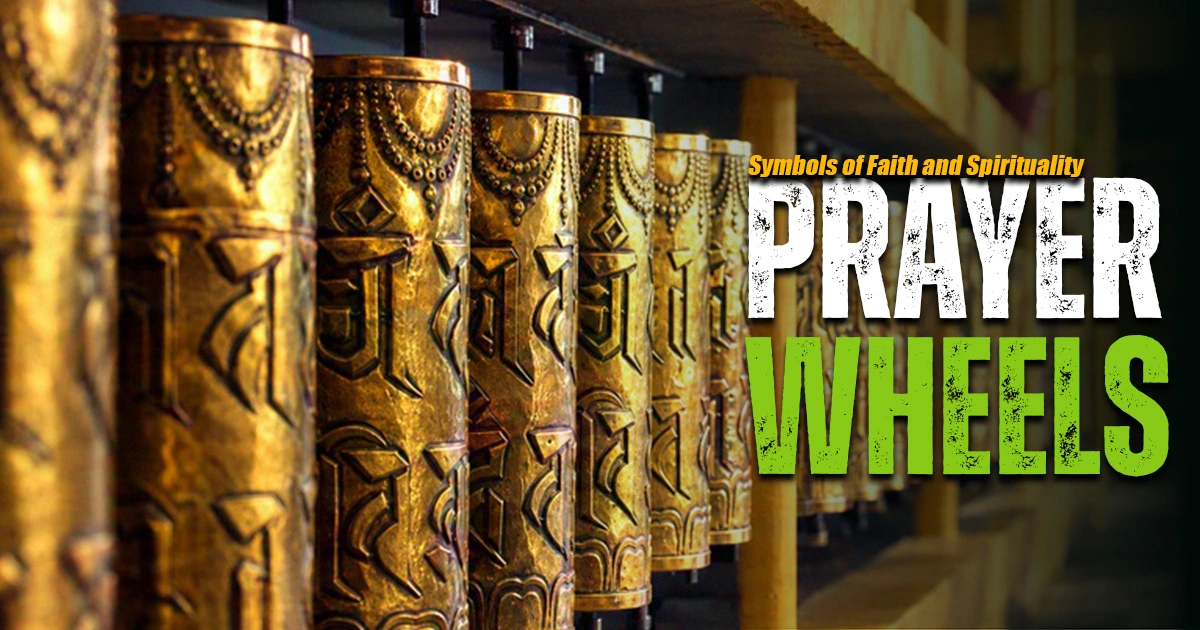
The materials used to make prayer wheels are often chosen with care. Copper is the most common material, although brass and sometimes silver are also used. The Outer surface is often decorated with sacred mantras, lotus designs, and images of Buddhist deities. Some prayer wheels are more elaborate and may include precious stones, fine metalwork, or gold-plated details.
At the center of the wheel is a rod that allows it to spin smoothly. While it serves a practical purpose, it also carries symbolic meaning in Buddhist tradition. The central rod is often seen as representing the connection between the physical and spiritual worlds, bringing together movement and stillness within a single object.
Types of Prayer Wheels
1. Handheld Prayer Wheels :
Handheld prayer wheels are the most common type. Small and easy to carry, they fit within a single grip. The wheel spins with a gentle movement of the wrist or forearm. A weighted drum is attached to the handle by a short metal chain, helping it rotate smoothly.
Pilgrims often carry these prayer wheels while walking along mountain trails, and monks use them during daily prayers and temple rituals. With regular practice, spinning the wheel becomes a natural and peaceful action, performed slowly and mindfully rather than in a hurry.
2. Monastery Prayer Wheels:
Spinning clockwise, monastery prayer wheels are large drums fixed beside temple corridors. Travelers gently push them as they walk past stone walls and sacred buildings. Each touch sets the wheel in motion, creating a calm and steady rhythm.
One rotation follows another without stopping, as different people take turns spinning them. This continuous movement creates a quiet sense of focus and devotion in the open air as people pass by.
3. Water-powered Prayer Wheels:
Spinning continuously, water-powered prayer wheels use the flow of rivers to turn their cylinders. They are usually placed beside mountain streams in places like Bhutan, Tibet, and parts of Nepal.
These wheels are often found near monasteries or sacred sites, where water naturally flows downhill. The movement of the water alone keeps them spinning, without any human effort or machines. Their constant motion symbolizes prayers being carried forward by nature itself, flowing endlessly just like the rivers that move them.
4. Wind-powered Prayer Wheels:
Wind-powered prayer wheels are placed in open, windy areas such as hilltops, mountain passes, or monastery roofs. When the wind blows across these places, it naturally turns the wheels without any human effort. The stronger the wind, the faster the wheels spin.
5. Fire-powered Prayer Wheels:
Fire-powered prayer wheels are turned by the warmth rising from flames. The hot air created by the fire makes the wheel spin without anyone touching it. These types of prayer wheels are usually found inside temples or shrines, where heat naturally moves upward and keeps them rotating.
In Buddhist belief, continuous spinning is seen as continuous blessings. Each turn is thought to spread kindness and positive energy further and further. The idea is that when the wheel keeps moving, good intentions also keep spreading without stopping. One rotation leads to another, creating a constant flow of prayers and goodwill that never ends.
Prayer Wheels across the Himalayas
Prayer wheels are a common and meaningful sight across the Himalayas, especially in Tibet, Nepal, and Bhutan. Although the idea is the same in all three places, their appearance and use blend naturally with local culture and daily life.
- Tibet
Deep within Tibet, prayer wheels have one of their oldest and strongest connections. They are not just objects but part of daily spiritual practice. You will see them in monasteries, along pilgrimage paths, and even on streets in towns. People often spin them while walking, believing each turn spreads compassion and blessings. Large rows of wheels are also fixed along monastery walls, where pilgrims slowly move past them in a meditative rhythm.
Mount Kailash is one of the most important sacred places for this practice. Travelers circle the mountain slowly, often turning prayer wheels the whole time. This movement connects walking, prayer, and belief into one continuous spiritual act.
- Nepal
In Nepal, spinning prayer wheels is one of the most visible forms of spiritual practice. At places like the Boudhanath Stupa in Kathmandu, one of the largest stupas in the world, rows of prayer wheels are placed along the circular path around the monument.
Especially in Himalayan regions like Mustang, Dolpo, and around trekking routes, prayer wheels are closely tied to village life and travel. They appear at monasteries, chortens(stupas), and trail entrances. Pilgrims and trekkers walk clockwise around the stupa and gently spin each wheel as they pass, which makes them part of both spiritual practice and everyday journeys.
- Bhutan
In Bhutan, prayer wheels are an important part of Vajrayana Buddhist practice and are carefully placed in dzongs (fortress-monasteries), temples, and village pathways. They are designed with attention and respect, often becoming a key feature of religious spaces. In high mountain valleys, you can often see water-powered prayer wheels placed along riverbanks.
Larger prayer wheels found in temples and religious sites are often beautifully decorated. They may have gold-colored details and fine carvings, showing the care and devotion put into their creation.
- Himalayan Communities in India
Prayer wheels are also found in the high-altitude regions of India, especially in Sikkim, Ladakh, and Arunachal Pradesh. In these places, they often reflect local art and craftsmanship, so their designs may look different from region to region.
Even though their appearance changes, their meaning and purpose remain the same everywhere. They are still used as a way of prayer and devotion in Buddhist practice. Across different landscapes and cultures, the spiritual role of the prayer wheel does not change.
Om Mani Padme Hum & Its Connection to the Prayer Wheel
Within Tibetan Buddhism, the mantra Om Mani Padme Hum is closely connected with prayer wheels. It is a short but very powerful chant made of six syllables, and it is believed to represent the teachings of the Buddha about compassion and kindness.
Even though the phrase is simple, it carries deep meaning in Buddhist practice and tradition. Each sound is believed to help reduce negative thoughts and harmful behavior linked to different states of human existence.
The mantra is also connected to Avalokiteshvara, the enlightened being linked with empathy, seen also as an embodiment of insight shaped by care. When people recite or spin prayer wheels containing this mantra, they are expressing devotion to compassion and trying to develop a more peaceful and caring mind.
Across the Himalayas, the mantra Om Mani Padme Hum is seen in many places, not just on prayer wheels. It is carved into rocks, painted on stones, written on colorful flags, and placed above temple doors. It appears wherever people can mark a surface, showing a shared hope for peace and freedom for all beings.
Each rotation is believed to send care outward, reaching even unseen places and people. The direction of the spin is less important than the steady repetition. With every turn, meaning quietly builds and then settles back into stillness, like a calm and continuous flow of breath.
FAQs about the Prayer Wheels
1. What is written inside a prayer wheel?
Inside a prayer wheel, sacred Buddhist mantras are written on paper scrolls. The most common mantra is ‘Om Mani Padme Hum’, which is repeated many times inside the wheel. Not every wheel holds only that chant; certain versions include extra texts drawn from old teachings.
2. Which direction should a prayer wheel be turned?
A prayer wheel should be turned clockwise. This is done in the same direction as the sun and is considered respectful in Buddhist tradition.
3. Is it permitted for guests to turn the prayer wheels?
Yes, guests and tourists are usually allowed to turn prayer wheels. However, it should be done gently, respectfully, and in a clockwise direction.
4. Are prayer wheels found beyond Tibetan Buddhism?
Yes. While they are most common in Tibetan Buddhism, prayer wheels are also found in regions influenced by Buddhism such as Nepal, Bhutan, Mongolia, and parts of India like Ladakh, Sikkim, and Arunachal Pradesh.
5. What does Om Mani Padme Hum mean?
‘Om Mani Padme Hum’ is a sacred mantra linked to compassion. It is often interpreted as a call for kindness, mercy, and spiritual awakening, especially associated with the Bodhisattva of compassion, Avalokiteshvara.
6. How old are prayer wheels?
Prayer wheels are believed to have been used for many centuries, with origins commonly linked to early Tibetan Buddhist traditions, possibly developing around 1,000-1,500 years ago.
Comments (0)
Write a commentRead the latest Blogs & Insights
Explore our collection of articles and insights to gain in-depth travel knowledge, expert advice, and stay updated on the latest trends and tips.
View All Articles
Vishwakarma Puja
18 Sep. 2026

Broad Peak Avalanche: Nirmal Purja & the Team
10 Aug. 2026
Prayer Flags
10 Jul. 2026


No comments yet.