


Chitwan National Park Safari Tour
Generally, when thinking about Nepal, one might immediately picture majestic mountains and historic, palaces and temples. The Terai (low Land), a region of level plains that borders North India, offers a different kind of safari experience, Chitwan National Park Safari Tour is one of the popular safari tours in Nepal that lies on the subtropical jungle listed as a world heritage property
-
 Sobit Bhandari
-
20 December, 2024
-
22 mins read
-
1984 Views
-
0 Comments


Generally, when thinking about Nepal, one might immediately picture majestic mountains and historic palaces, and temples. The Terai (lowland), a region of level plains that borders North India, offers a different kind of safari experience. Chitwan National Park Safari Tour is one of the popular safari tours in Nepal that lies in the subtropical jungle, listed as a World Heritage property.
Chitwan National Park is Nepal’s first national park and one of the country’s most famous wildlife destinations. This national park was established in 1973 and recognized as a UNESCO World Heritage Site. The park is known for its rich biodiversity and well-preserved natural habitat. Chitwan is home to rare wildlife like the one-horned rhinoceros, Bengal tiger, gharial crocodile, and over 500 species of birds. With activities such as Jeep safaris, jungle walks, canoe rides, and cultural experiences with the Tharu community, Chitwan National Park offers an exciting mix of adventure, nature, and culture.
Chitwan is the stuff of jungle safari fantasies; if you're lucky, you might even see a Royal Bengal Tiger (although your chances of seeing one are better in the Bardia National Park, further west on the Terai). You can also see elephants, rhinos, gharial crocodiles, and other exotic animals.
Tharu are the native inhabitants of the Chitwan region, and they have a culture, language, and cuisine distinct from Nepali civilizations found at higher elevations. Numerous Tharu have been forced from their original lands and sidelined by "mainstream" Nepal for centuries, but visitors may now find many opportunities to learn about Tharu.
Where is Chitwan National Park located?
Chitwan National Park is in the south-central part of Nepal, in the lowland Terai region. It covers areas of Chitwan, Nawalpur, Parsa, and Makwanpur districts. The park is about 150 km southwest of Kathmandu, and is easy to reach by road or by flight.
It lies at an altitude of 100-815 meters and is bounded by the Rapti, Narayani, and Reu rivers, which provide an ideal natural home for a variety of wildlife. Its strategic location in the tropical plains makes Chitwan one of Nepal’s most important and popular destinations for jungle safaris and wildlife adventures.
Remember that "Chitwan" refers to a whole district in Nepal that reaches far into the hills. Be sure to mention the national park, not just the district, when making travel arrangements to the national park.
Why Chitwan National Park for Safari Tours?
Chitwan is a joyful fusion of nature and humanity, created through the harmonious coexistence of wildlife and people, where thousands of travellers go to experience real wildlife and nature.

Chitwan National Park is home to aquatic, terrestrial, amphibious, and many other animals, as well as birds. During the Chitwan Jungle Safari Tour, we take you to the deep sal forest, Tharu villages, Rapti River, and Chitwan National Park, the habitat of the great one-horned rhinoceros and Royal Bengal Tiger.
Whether it's bird viewing or the breathtaking sunset vista from the Rapti River, Chitwan's wildlife safaris have never failed to entertain the audience. One can experience Chitwan to its fullest potential with suitable lodging options and a well-managed environment. The native Tharus are endearing and friendly.
Jeep safaris, jungle walks, boating/canoeing, Tharu cultural programs, elephant bathing, bird-watching tour, and a visit to the Elephant Breeding Center are the main attractions for tourists in Chitwan.
Best time for Chitwan National Park Safari
- The best time to visit Chitwan National Park is from October to March, when the weather is dry, pleasant, and ideal for wildlife viewing. During these months, temperatures are moderate, humidity is low, and the trees, bushes, and plants in the jungle lose some of their leaves and become less dense so that we can spot endangered species like the one-horned rhino, Bengal tiger, and various bird species.
- January to March is peak wildlife-spotting season, as animals frequently emerge around rivers and open grasslands.
- While April to early June is hotter, it can still be rewarding for safaris because animals gather around water sources.
- Monsoon season (June-September) is the least ideal time due to heavy rains, slippery trails, and limited safari options.
How to get to Chitwan National Park?
Reaching Chitwan National Park is easy from both Kathmandu and Pokhara, with options by road and air.
By Road:
Most travellers enter the park through Sauraha, the main gateway. It is located about 156 km (96.9 miles) from Kathmandu and 144 km (89.4 miles) from Pokhara. The drive from either city typically takes 5 to 6 hours, depending on road conditions and traffic. Tourist buses, private cars, and jeeps regularly operate on this route.
By Air:
For a quicker journey, you can take a short 17-20 minute flight from Kathmandu or Pokhara to Bharatpur Airport. From the airport, Sauraha is only 16 km away, which takes about 25-30 minutes by taxi or hotel transfer. There are a few regular daily flights from Kathmandu to Bharatpur, while there is only one flight from Pokhara to Bharatpur.
Contact for Tourist Bus Ticket or Flight to Pokhara +977-9849615880
Natural Things to see during the Chitwan National Park Safari Tour
Specialities of Chitwan National Park
The significant specialties of the Chitwan National Park Safari are the wide range of Flora and Fauna, birds, and Mammals found here.
Flora
Sal trees cover over 70% of the Chitwan National Park due to the presence of Himalayan subtropical broadleaf forests in the interior of Terai. The purest stands of Sal trees can be found in the center's well-drained lowland area. During religious offerings and holidays, locals prepare plates with leaves from the sal tree. 20% of the remaining area of Chitwan National Park is made up of grasslands. Sal, interspersed with Chir pine, covers the park's southern slope.
At the same time, small flowering trees and shrubs such as Beleric, Axlewood, Rosewood, etc., as well as creepers like Spatholobus parviflorus and Bauhinia valid, are found on the park's northern slopes. The park's grassland is home to more than 50 kinds of grass. Elephant grass (Saccharum spp.), one of the grasses, is well known for its tremendous height because it may reach heights of up to 8 meters. The grasslands also contain several different varieties of natural grasses. The Kans grass, the first to colonize new sandbanks, is washed away each year by the monsoon.
Fauna

More than 700 different types of wildlife now call Chitwan National Park home. Along with the king cobra and rock python, this area is also home to 17 other kinds of snakes, monitor lizards, and tortoises. The park is home to a countless variety of butterflies, moths, and other insects. The Narayani-Rapti River system and numerous oxbow lakes are home to at least 113 fish species and mugger crocodiles.
Early in the 1950s, there were about 235 gharials found in the Narayani River; by 2003, only 38 were left. As a result, gharial eggs are gathered along rivers to be incubated in the breeding facility of the Gharial Conservation Project. From the ages of six to nine, the animals are raised there.
Mammals

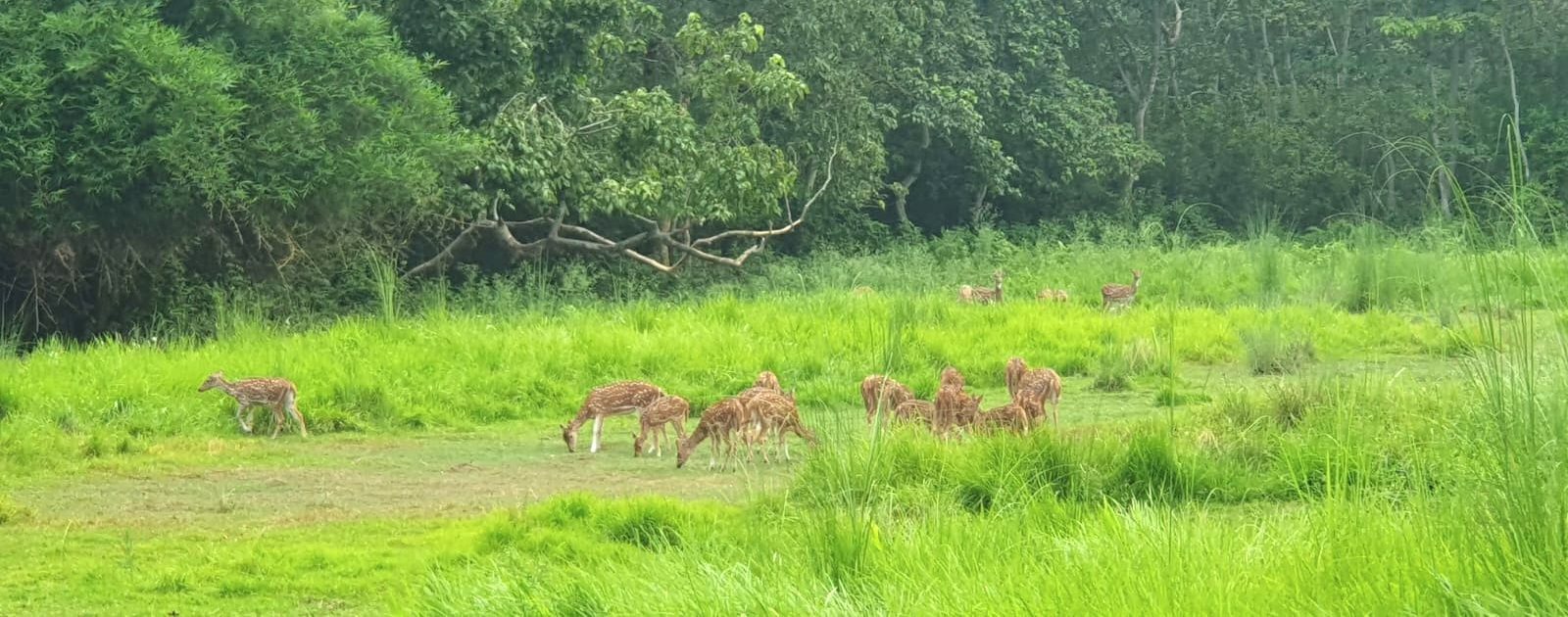
Chitwan National Park is one of Nepal’s richest wildlife habitats, home to more than 60 species of mammals, making it a prime destination for jungle safaris and wildlife photography. The park is world-famous for its population of Royal Bengal tigers and the one-horned rhinoceros, both of which are major attractions for visitors. You can also spot Asian elephants, gharials, sloth bears, leopards, wild boars, and different species of deer, such as the sambar deer, spotted deer, and hog deer.
Its original population of 25 animals was grown to 70-110 in 1980, but it has declined due to poaching and flooding in some years. According to data gathered from camera traps, there were 4.44 to 6.35 tigers per 100 square kilometers in 2010 and 2011. It was determined that the tigers' daily activity patterns were at their lowest while people watched them.
Birds

In 2006, it was discovered that Chitwan National Park was home to 543 bird species. The national park is home to nearly two-thirds of the globally endangered birds in Nepal. Twenty black-chinned Yuhina, two Gould's Sunbirds, two blossom-hearted parakeets, and one slaty-breasted rail were all seen and counted in the spring of 2008.
The alluvial grasslands of the national park are known to be home to several kinds of grass warblers, including the Bengal florican, lesser adjutant, grey-crowned Prinia, swamp francolin, and other critically endangered bird species.
More than 200 slender-billed babblers were sighted in 3 different grasslands in 2005. Chitwan National Park has become a breeding ground for one of the endangered spotted eagles worldwide. The Chitwan National Park is home to numerous other bird species, including the Oriental darter, egrets, bitterns, storks, kingfishers, Peafowl, and jungle fowl. 160 different kinds of migratory birds, in addition to those that live there permanently, arrive at the national park in the fall to spend the winter.
The Eastern Imperial Eagle and Pallas's Fish-Eagle are the most visible of the avian eagle species. Birds from southern latitudes arrive in the park during the summer at the same rate that the winter migrants do. The cuckoo's sounds signal the beginning of spring. The vibrant pitta and other species come to the park during the monsoon season to procreate.
Best Itinerary for Chitwan National Park Safari
Chitwan National Park Safari Tour is the best itinerary for a 3-night 4-day tour, which also includes major activities in the Chitwan National Park, the Animal Sanctuary, local village exploration, and the jungle safari. In it, you are picked up from Pokhara or Kathmandu and driven in a luxurious bus to Chitwan, where you check into a hotel on the outskirts of the Sanctuary.
You spend four days and three nights at the resort participating in various activities. Visits to Tharu villages to see daily life, as well as cultural dances and performances, are among these activities. Visiting an elephant breeding facility, taking an elephant bath, kayaking, bird-watching, cycling, going on nature walks, and going on an elephant safari, or a jeep safari into the wilderness with a naturalist are all examples of activities. The scheduling created for this standard package is as follows:
● Day 1: You are picked up from Kathmandu or Pokhara on this day and driven to Chitwan, on the outskirts of the sanctuary, where you check into a hotel. After lunch, you visit a nearby Tharu village to learn about their way of life. For dinner and bed, you come back.
● Day 2: You get up early to eat breakfast and watch the birds at work. After that, you may take a boat down a river to see if you can spot any fish or crocodiles, or you could walk through a forest with a naturalist to see if you can spot any creatures. After returning and eating lunch, we go on a jeep safari with a naturalist into the woods to look for game and snap some beautiful shots. The next stop is an elephant breeding facility where visitors can observe the taming of elephants. To eat and sleep, return to the resort.
● Day 3: You once more got up early to eat breakfast and go bird-watching. After that, you and a naturalist will cycle through the jungle. After lunch, you'll go on a jeep safari with your naturalist to discover the forest's best-kept secrets. Dinner and bedtime upon your return.
● Day 4: After breakfast and a morning of bird viewing, we board a luxury bus and travel to Pokhara or Kathmandu.
Contact us for any tour of Chitwan National Park at +977-9849615880 WhatsApp / Viber
Main Activities to do during the Chitwan National Park Safari Tour
There are numerous ways to view wildlife and birds, which dominate activities in the Chitwan National Park.
Safaris by Jeep

Jeep is the main and best way to explore the park. It explores dense forests to observe wild animals and their activities. Each jeep has one or two experienced, naturalist guides who stop in the main wild animal transit area and give information about it. Nature guides are extremely aware of the animals and birds, as well as the ideal locations to discover them, depending on the time of day.
Safaris on foot (Jungle Walk)
Going on foot is an excellent substitute for the safaris mentioned above. Going on foot is more tranquil than travelling by jeep, and it may allow you to get near some creatures that might flee at the sound of a Jeep. There is, however, a sizable element of risk. Although they are one of the park's biggest draws, the hundreds of one-horned rhinos calling Chitwan home are dangerous to come across on foot, even with the most excellent guides. Be mindful of these dangers, and send the kids home.
Canoe Rides
It's a terrific chance to see various birds, take in the scenery quietly, and get a close-up view of thin-snouted gharial crocodiles to go along the Rapti or Narayani Rivers in a traditional dug-out canoe. Despite being extremely endangered, these crocodiles are surprisingly plentiful in Chitwan.
Cycling Through Villages
Cycling is a terrific method to travel around and see local life in the Terai because it is flat and the villages and towns are small. Bicycle rentals and even guided tours are frequently available at hotels and guesthouses. Rice and other crops are farmed outside the national park's boundaries, and a bike ride at dusk is a great way to end the day.
Tharu Cultural Performances

Local Tharu people are ready to share their culture with guests since they are proud of it. Young Tharu people have the same shortage of chances as people elsewhere in Nepal, and many of them—particularly men—emigrate to the cities or other countries in search of employment. Some cultural programs have been developed to keep young Tharu in their communities and preserve their customs. Many resorts present cultural Tharu performances that include singing, dance, and traditional attire. Even if they can come off as a little "touristy," they contribute to preserving and showcasing a group's unique culture.
Bird watching
Around 600 different bird species, both permanent and migratory, make Chitwan National Park is also a great spot to watch birds. Here you can find about two-thirds of Nepal's globally endangered bird species. The Bengal florican, lesser adjutant, swamp francolin, and grass warblers are rare species that call the park's alluvial grassland home. Take a naturist-led birding tour to identify various birds and their whistles and alarm sounds.
Elephant Safari
The Chitwan jungle safari has three primary alternatives. The elephant safari is not recommended because it is abusive to the animals. You can read my post about visiting elephants in Chitwan if you'd like to learn more about how to see elephants there humanely, without torturing the animals. If you are unfamiliar with elephants' training methods, you should learn more before deciding on this course of action. Elephants are captured young and put through weeks or months of suffering. The elephant is trained for riding once it has been broken. From that point on, it is closely chained and kept in a small shelter unless it is used for a ride. It's pretty cruel.
Visit Elephant Breeding Center
According to the Elephant Breeding Center, elephants are among the most graceful animals. You will be taken to the Hattisar by our naturalists to see a demonstration of how the elephants are fed and cared for in the elephant breeding facility. They will describe the characteristics and behaviors of elephants. To domesticate elephants through trapping, the unique center was founded in 1985.
Visit Bis Hazari Taal
At the southernmost point of Bharatpur, in the Chitwan National Park's buffer zone, is the picturesque oxbow lake system known as Bishazari Tal. In addition to providing a stunning view of the lake, the biohazard Tal is a popular spot for bird watching. In the lake, several crocodiles have made themselves at home.
Religious and Cultural Tours
The traveller might go on religious and cultural trips in and around Chitwan after exploring the natural world. Participating in this activity awakens and deepens people's spiritual faith and beliefs.
Chitwan offers a unique experience of numerous lifestyles, ethnicities, and traditions in addition to the mesmerizing beauty of nature. You may learn about the way of life of those who live in Nepal's Terai region. Thanks to the distinctive traditions of several ethnic groups, including the Tharu and Chepang communities.
Accommodation in Chitwan National Park
Accommodation in Chitwan National Park
Chitwan National Park presents a wide range of accommodations to suit every traveller’s needs. From luxury jungle lodges with modern amenities, cultural programs, and private safari experiences, to mid-range hotels providing comfort and guided tours, there’s something for everyone. Budget guesthouses and homestays near Sauraha let travelers enjoy an authentic local experience, while jungle camps offer adventurous stays close to nature.
Food and Drinks in Chitwan National Park
If meals are included in the trip package, you are welcome to eat at the hotel's restaurant. If not, you can eat at one of the independent eateries on Sauraha's main street. Since Chitwan/Sauraha is a tiny town, there are fewer dining establishments and cuisine choices than in Kathmandu or Pokhara. However, locating eateries that serve meals to your preferences is still simple. Various cuisines, such as Nepalese, Continental, Indian, Thai, Chinese, etc., are available here.
Some restaurants offer a very relaxing dining atmosphere with views of a river or garden. When you travel to Chitwan, you are engaging in rural tourism because you directly impact the lives of several villagers and rural residents. There, they serve dishes with a uniquely traditional flavor. The local word of choice is Dal Bhat. Most of Chitwan's resorts and hotels serve native and western cuisine to appeal to visitors interested in animal viewing. You might eat food from Nepal, India, Thailand, the Himalayan Chinese, etc.
With so much diversity and culture from all around Nepal, Chitwan, also known as the 76th district of Nepal, is a special district in and of itself. You can find anything you want there. Along with this, Chitwan offers some of the best local cuisines. Some of the most famous foods of this area that you must try are:
● Nepali Thali Set: The beginning of the Nepali Thali set includes Mixed Taste of Bhatmas Sadako (roasted soybean), Alu Tareko (fried potato), and Suruwa (soup). As the main dish, the meal includes sada bhuja (rice), Kala dal (lentils), gravy chicken, roasted wild boar, Saag (seasonal fresh leaves), vegetables, and achar (homemade pickle). For dessert, Sikarni is served (Thick yogurt, shipped and mixed with dry nuts and cinnamon powder). Thalis are the ideal way to enjoy Nepali traditional cuisine because they allow you to sample a wide range of foods all at once while also saving you money.
● Tandoori Chicken: If you are an avid fan of Indian cuisine before developing this recipe for authentic tandoori chicken from an Indian restaurant that you can prepare in your home oven. You will never forget the taste of roasted chicken with yogurt and spices added, which adds to the flavor of the time.
● Chitwan ko Tass: In Nepalese restaurants, "Tass" is a well-known meal and a fantastic accompaniment snack. It is a spicy fried meal with goat meat. It has always been one of our favorite treats. Chitwan is renowned for its delectable, fresh "Taas" offerings. You will never forget the flavor of the fiery "Tass" there that was served with bhuja or cheura.
● Ghonghi: Ghonghi, one of the most popular delicacies in the Tharu community of Nepal, is frequently served as a delicacy, much like other people would serve chicken or mutton. This particular species of snail is eaten with ground linseed soup and is known as escargot in France, which is also considered a delicacy. This meal, which the Tharu community often consumes by sucking the snail from its shell, is readily available throughout Terai's market.
● Local Tharu Style Food: In Sauraha, numerous riverbank eateries serve traditional Nepalese cuisine. One of the major ethnic groups in Terai, the Tharu, is prepared to serve you delectable traditional fare while showing you the utmost respect.
Chitwan National Park Safari Tour Cost
We offer a variety of tour activities at the best possible cost. The cost of a tour depends on the tour activities you choose, the itinerary, and the number of participants, so prices might vary significantly. Typically, we operate a 2-night, 3-day inclusive package (including food, accommodation, and activities) for just $160, covering transportation from Kathmandu, Pokhara, or Lumbini. We also offer a 3-night, 4-day package for only $210.
Note, these are common packages if you are travelling with family and a big group with special activities, feel free to ask +977-9849615880
Community and Culture of Local People
The largest ethnic group, known as the Tharus, resides in Chitwan and has its own culture. They have a vibrant culture. Although they practice Hinduism, they have a marginally different culture from other Hindus. All people in Chitwan celebrate all the holidays because there are residents of other religions there.
Visitors to Chitwan National Park receive a most kind welcome from the local Tharu ethnic group. The visitors are mesmerized by the endearing customs and culture of the Tharu group of People, which offers a singular and enjoyable traditional experience while experiencing animals. The visitor can take in the cultural displays and performances of the Tharu community.
The Tharu Community Homestay, located outside of Chitwan, provides additional cultural experiences and the opportunity to mingle with local families. Traditional huts made of mud, clay, and grass are used as guest accommodations, and local art is used to decorate the inside.
Along with watching wildlife in the national park with local families, visitors can also try their hand at traditional net-based fishing. Villagers also perform traditional dances and dress for visitors.
Packing List for Chitwan National Park
Chitwan experiences a tropical monsoon climate, making it hot and muggy all year round. The park offers a wide range of activities, so you should pack accordingly. Some of the stuff you'll need for your jungle trip is listed below.
- Sunglasses
- Sun/rain hat
- Sunscreen (as you'll spend most of your time outdoors)
- Sturdy shoes are comfortable for walking
- Camera (with extra batteries) to shoot photos
- Binoculars for seeing animals
- Raincoat ( as Chitwan can be humid)
- Clothing: light-color long sleeves and long pants to avoid bug/mosquito bites
- Mosquito repellent
- Medications such as malaria pills
- Anti-itch cream for insect bites
- Water bottles for drinking water, to stay hydrated, and so on.
What to wear on a Chitwan Safari Tour?
It's crucial to dress in hues that blend nicely with your surroundings. Avoid wearing bright or attention-grabbing colors like red, white, or yellow, and instead choose neutral, subdued colors such as tan, brown, grey, or black. This is due to two factors. For starters, you don't want an animal to see you and become frightened and flee. And second, you don't want an animal to spot you and come after you.
It works best if you disappear. You should dress in layers if you intend to leave early in the morning before the sun rises or during the winter. Since the jeeps are open, it can be brisk and cold outside when they are moving. A thick cap and a windbreaker are essential. Monsoon season brings with it days of rain. Have a top-notch raincoat on hand.
Some FAQs of the Chitwan National Park Safari Tour
1. What is the best time to visit Chitwan National Park?
The ideal time is October to March, when the weather is pleasant, and wildlife sightings are easier. April to June can be hot, while July to September is the monsoon season.
2. What types of safari are available in Chitwan National Park?
Visitors can choose from jeep safaris, elephant safaris, canoe rides, and guided jungle walks. Each offers a unique way to explore wildlife and nature.
3. Which animals can I see on a safari?
You can spot Bengal tigers, one-horned rhinoceroses, elephants, spotted deer, wild boars, crocodiles, and a variety of birds. Sightings depend on the season and time of day.
4. How long does a typical safari last?
Most safari tours last 2 to 4 hours, but full-day safaris are also available for a more immersive experience.
5. Do I need a permit to enter Chitwan National Park?
Yes, a park entry permit is required. Foreign visitors typically pay a higher fee than locals, and the permit can be purchased online or at the park entrance.
6. Are there accommodations inside or near the park?
Yes, Chitwan has a range of lodges, resorts, and jungle camps, from budget to luxury options, often with guided safari packages included.
7. What should I wear for a safari?
Wear light, comfortable clothing in neutral colors, a hat, sunglasses, and sturdy shoes. Avoid bright colors to prevent disturbing wildlife.
8. Is it safe to go on a safari?
Yes, as long as you follow your guide’s instructions. Avoid feeding or approaching wild animals. Jeep and elephant safaris are generally very safe.
9. Can children join the safari tour?
Yes, children are welcome, but some activities, like elephant rides, may have age or height restrictions. Always check with the tour operator.
Comments (0)
Write a comment- Where is Chitwan National Park located?
- Why Chitwan National Park for Safari Tours?
- Best time for Chitwan National Park Safari
- How to get to Chitwan National Park?
- By Road:
- By Air:
- Natural Things to see during the Chitwan National Park Safari Tour
- Specialities of Chitwan National Park
- Best Itinerary for Chitwan National Park Safari
- Main Activities to do during the Chitwan National Park Safari Tour
- Safaris by Jeep
- Safaris on foot (Jungle Walk)
- Canoe Rides
- Cycling Through Villages
- Tharu Cultural Performances
- Bird watching
- Elephant Safari
- Visit Elephant Breeding Center
- Visit Bis Hazari Taal
- Religious and Cultural Tours
- Accommodation in Chitwan National Park
- Chitwan National Park Safari Tour Cost
- Community and Culture of Local People
- Packing List for Chitwan National Park
- What to wear on a Chitwan Safari Tour?
- Some FAQs of the Chitwan National Park Safari Tour
- 1. What is the best time to visit Chitwan National Park?
- 2. What types of safari are available in Chitwan National Park?
- 3. Which animals can I see on a safari?
- 4. How long does a typical safari last?
- 5. Do I need a permit to enter Chitwan National Park?
- 6. Are there accommodations inside or near the park?
- 7. What should I wear for a safari?
- 8. Is it safe to go on a safari?
- 9. Can children join the safari tour?
Read the latest Blogs & Insights
Explore our collection of articles and insights to gain in-depth travel knowledge, expert advice, and stay updated on the latest trends and tips.



No comments yet.