


Hillary Step on Mount Everest: The Rock Face Near the Top
Introduction High above sea level, near the summit of Mount Everest, lies a narrow rocky passage known for both legacy and risk. Positioned just below the highest point on Earth, this steep section confronts climbers during the final moments of the ascent. Since 1953, those attempting the summit have encountered its demands. Though short in […]
-
 Bold Himalaya
-
24 February, 2026
-
18 mins read
-
17 Views
-
0 Comments


Introduction
High above sea level, near the summit of Mount Everest, lies a narrow rocky passage known for both legacy and risk. Positioned just below the highest point on Earth, this steep section confronts climbers during the final moments of the ascent.
Since 1953, those attempting the summit have encountered its demands. Though short in length, it has long been regarded as the final major barrier on the standard route—brief in distance, yet heavy in consequence. More than stone and ice, it reflects the physical and mental strain of moving upward in thin air, where progress is shaped by terrain, exposure, and resolve.
What Is the Hillary Step?
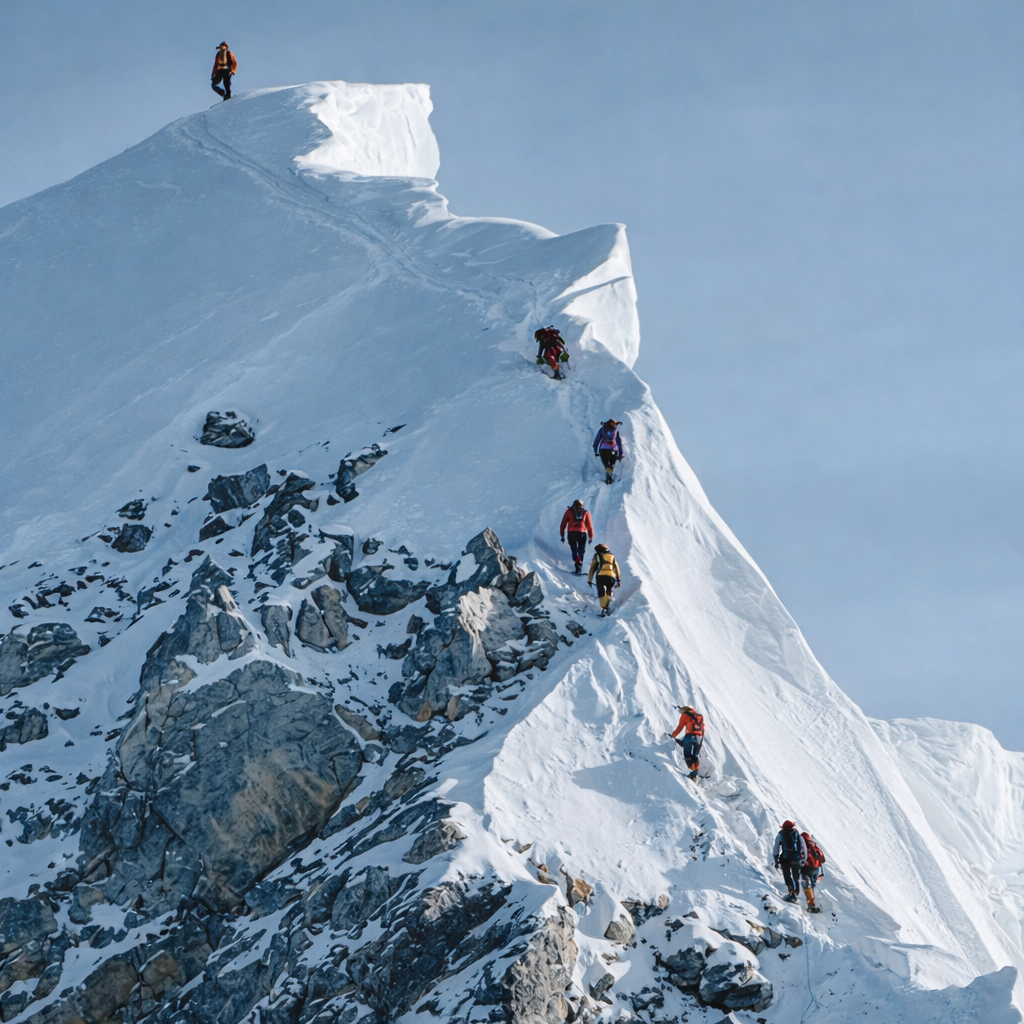
The Hillary Step is a steep rock-and-snow feature located high on Everest’s Southeast Ridge. Rising approximately 12 to 15 meters (about 40 feet), it appears modest in height. However, at an elevation of roughly 8,790 meters, where oxygen levels drop to about 30 percent of those at sea level, even simple movement becomes exhausting. Ascending this short section requires careful technique, balance, and sustained effort under extreme physiological stress.
Geologically, the Step formed from layers of limestone and compacted rock, interrupting the otherwise snow-covered ridge. Before changes reported after 2015, it demanded mixed-climbing skills across rock, ice, and hard-packed snow while exposed to steep drop-offs on both sides. Its position between the South Summit and the true summit makes it unavoidable on the standard South Col route, turning it into a decisive point where climbers must either continue upward or begin their descent.
Location of the Hillary Step on Mount Everest
The Hillary Step is located high on the Southeast Ridge of Mount Everest at an elevation of approximately 8,790 meters (28,839 feet) above sea level. It lies along the narrow ridge connecting the South Summit (8,749 m) and the mountain’s true summit at 8,849 meters, placing it within the final stretch of the standard South Col route.
The approach begins from the South Col at roughly 7,906 meters, where climbers typically depart around midnight for their summit attempt. From there, the route ascends to the Balcony at about 8,400 meters before continuing to the South Summit. Beyond this point, climbers traverse an extremely exposed, corniced ridge of snow and ice with steep drop-offs on both sides, leading directly to the base of the Hillary Step.
Historically, a near-vertical rock face measuring around 12 meters in height, the Hillary Step was altered by seismic activity during the 2015 Nepal earthquake. In recent climbing seasons, it has been reported as a steep snow-and-ice slope reinforced with fixed ropes to assist climbers moving through the Death Zone. Because this section lies on the only practical line of ascent from the Nepal side, it remains unavoidable, a decisive point roughly 60 meters below the highest point on Earth, where fatigue, altitude, and exposure leave no margin for error.
Historical Significance: The Birth of a Legend
On the morning of May 29, 1953, Mount Everest witnessed its first verified human summit. Two days earlier, Tom Bourdillon and Charles Evans had climbed to the South Summit, roughly 90 meters below the peak. Though forced to turn back due to failing experimental oxygen systems, their effort proved critical. They scouted the final ridge and left behind oxygen canisters that would later aid Sir Edmund Hillary and Tenzing Norgay in completing their historic ascent.

Departing from the South Col along the Southeast Ridge, Hillary and Tenzing encountered a formidable 12-meter (40-foot) vertical rock face, which would become known as the Hillary Step. Hillary later described discovering a narrow crack between the rock and a hanging ice cornice:
"I jammed my way into this crack, then kicking backwards with my crampons, I sank their spikes deep into the frozen snow behind me and levered myself off the ground... with a fervent prayer that the cornice would remain attached to the rock."
Using this “chimneying” technique, Hillary ascended the obstacle and pulled Tenzing up behind him. Their successful negotiation of the Step allowed them to reach the true summit at 11:30 a.m., where they spent just 15 minutes taking photographs and burying a small cross in the snow. Hillary later remarked to his teammate George Lowe with characteristic understatement: "Well, George, we knocked the bastard off."
The Legacy of the Hillary Step
That 12-meter crack became immortalized as the Hillary Step, a symbol of both technical skill and human determination. The 2015 Nepal earthquake physically altered the formation, transforming it into a steep snow-and-ice slope sometimes referred to as the “Hillary Slope.” Today, climbers ascending via the South Col route navigate this section using fixed ropes, modern equipment, and careful attention to altitude and exposure.
Yet despite structural changes, the Hillary Step retains its historical and symbolic significance. At roughly 8,790 meters, it stands as the final major barrier before the summit, a place where the courage and ingenuity of 1953 meet the high-altitude challenges faced by climbers today.
Every ascent through this stretch connects modern mountaineers with the legacy of Hillary and Tenzing, reminding them that Everest is more than a mountain; it is a testament to human perseverance.
Did the Hillary Step Collapse? The Final Verdict
Ever since the powerful 2015 quake struck Nepal, shaking the entire region at magnitude 7.8, discussion among climbers has remained active. That disaster altered landscapes throughout the Himalayas, bringing devastation far beyond its epicenter.
On Everest, one result stood out sharply: massive avalanches set into motion by violent tremors below. Though time passes, uncertainty still lingers about the long-term impacts of such natural forces. The event reshaped how people view risks in extreme altitudes.
Climbers reaching the top in 2017, following two years of closure due to the earthquake, reported noticeable differences in the Hillary Step. British mountaineer Tim Mosedale, summiting for the sixth time on May 16, posted on Facebook: "It's official—the Hillary Step is no more."
Rather than its former height, he observed a reduced profile where solid rock had given way under pressure. Instead of a clear vertical section, seasoned guides saw what resembled a slanted field of loose debris covered in snow. "A big piece of rock had definitely fallen off," said guide Bill Allen, who climbed the Step in 2011 and again in 2016. "It was totally different from what I saw in 2011." Where once there was a firm ascent point, now lay a shifting incline shaped by time and force. The structure they remembered distinctly seemed altered beyond prior descriptions.
Disagreement existed among individuals. Within mountaineering circles, opinions diverged. Nepali officials pushed back, Ang Tshering Sherpa, president of the Nepal Mountaineering Association, told CNN: "This is a false rumour. Hillary Step is intact. It's only that a small portion of the rock is visible; the rest is under snow." Pasang Tenzing Sherpa, a high-altitude guide, noted that the route had been moved 5 to 8 meters right in 2016 for safety, which may have contributed to confusion. Others, like four-time summiteer Wally Berg, offered a middle view: "The Hillary Step presents itself differently each year, depending on how much snow is on the route."
By June 2017, photographic evidence brought clarity. American climber Garrett Madison, on his eighth summit, captured before-and-after images showing the main boulder, the defining feature of the Step, completely missing. Dave Hahn, who has summited Everest 15 times (more than any non-Sherpa), reviewed the photos and concluded: "The photos show pretty conclusively that a large mass of rock is missing. I'd say that boulder is absolutely gone." Later that year, guide and photographer Lhakpa Rangdu displayed 11 years of Step photos at Nepal Tourism Board, providing visual proof of the transformation.
The 2026 Reality: From "Step" to "Slope"
The agreement now points to fundamental changes within the structure. The main boulder fell, most likely shaken loose by the 2015 earthquake. What remains is a 45-to-60-degree slope of snow and ice, with "huge unstable rocks perched on the route," as Mosedale described it. Many expedition leaders now refer to this section as the "Hillary Slope", a term that reflects its transformed nature.
While the technical "rock scrambling" is gone, the transition has introduced new, objective hazards. Unlike solid rock, the snow slope is volatile. On May 21, 2024, a massive cornice collapse near the Step swept several climbers down the Kangshung Face. Two climbers—British mountaineer Daniel Paul Paterson and guide Pastenji Sherpa were never recovered. IFMGA guide Vinayak Malla, who witnessed the collapse, described the scene: "After summiting, we crossed the Hillary Step, traffic was moving slowly, then suddenly a cornice collapsed a few meters ahead of us... Four climbers almost perished".
The 2024 tragedy proved what experts had warned: the modern "ramp" can be more treacherous than the original stone. Loose debris remains a constant threat, with climbers in the 2025 and 2026 seasons reporting shifting rocks within the snow, creating risk of rockfall for those below.
To manage persistent bottlenecks at this new "slope," 2026 protocols now require dual fixed lines—separate ropes for ascending and descending traffic—preventing lethal delays in the Death Zone where oxygen is scarce and waiting can mean death.
The Verdict
The Hillary Step didn't disappear; it evolved. In 2026, the challenge has shifted from technical rock climbing to high-altitude snow-craft and traffic management. Though still present, the obstacle's nature seems altered—less sheer cliff, more unstable blend of incline and debris. Easier? Not necessarily; opinions differ on whether risk has changed form rather than decreased. What remains certain is that this passage, shaped by earth's forces, still stands as the most decisive and unpredictable point on the mountain.
Climbing the Hillary Step Today: The 2026 Reality
Upon nearing the Hillary Step today, climbers no longer encounter a vertical rock wall, but a steep 45-to-60-degree snow and ice ramp—now commonly called the "Hillary Slope" by expedition guides. To safeguard this passage, expert Sherpa crews install dual fixed lines, a 2026 protocol designating one rope for ascent and another for descent. These cables are the primary lifeline for the hundreds of climbers navigating the Death Zone each season. "The fixed rope is a lifeline" at this altitude, where a single mistake can end an expedition.

Technical Challenges at 8,790 Meters
Despite the support of fixed lines, conditions remain brutally severe. Temperatures here range from -20°C down to -35°C (-4°F to -31°F), with winds exceeding 160 km/h (100 mph). The exposure is staggering: drops of 3,000 meters (10,000 feet) to the Western Cwm on one side and 2,400 meters (7,900 feet) to the Kangshung Face on the other.
In 2026, the challenge is defined by three critical factors:
Mechanical Complexity: Handling mechanical ascenders (Jumars) and carabiners while wearing heavy down mittens is a high-stakes dexterity test. Any error here, just 60 meters below the summit, can be fatal.
Oxygen Management: The Step remains the most dangerous bottleneck on Earth. During "summit waves," a climber may wait in line for over 90 minutes. This static waiting depletes oxygen reserves rapidly, making efficient flow-rate management a matter of survival.
Modern Safety Gear: Under 2026 regulations, all climbers must carry GPS tracking chips and RECCO reflectors. Because the snow ridge near the Step has become increasingly unstable, highlighted by the May 21, 2024, cornice collapse, these devices are now mandatory for rescue and recovery operations.
An eyewitness to the 2024 tragedy described the scene: "After summiting, we crossed the Hillary Step, traffic was moving slowly, then suddenly a cornice collapsed a few meters ahead of us... four climbers almost perished". British mountaineer Daniel Paul Paterson and guide Pastenji Sherpa were never recovered.
Human Impact and Crowding
At this stage, safety demands full attention. Oxygen levels require constant checking, as does the planned descent moment, along with how fellow climbers act. The urge to reach the top despite clear risks grows strongest in spots such as the Hillary Step, where success seems near, and retreat appears unreasonable. "Once reaching here, it's a do-or-die thing". What lies ahead depends heavily on judgment under pressure.

Today's ascent involves greater support than the 1953 expedition—better gear, fixed ropes, weather forecasting—yet the sheer volume of people creates "unfamiliar dangers." While Hillary and Tenzing faced the unknown alone, a 2026 climber may share the ridge with over 200 others in a single 24-hour window. This density turns the Hillary Step into a test of judgment: climbers must decide if their remaining oxygen and physical strength can survive a two-hour traffic jam, or if the only safe choice is to turn back.
Early pioneers did not deal with such challenges at all—they faced a vertical rock wall with no crowds, no fixed ropes, and no expectation of rescue. Today's climbers face a different mountain: less technical, perhaps, but with hazards of its own making.
Interesting Facts About the Hillary Step
- The Origin of the Name: Sir Edmund Hillary and Tenzing Norgay did not name the feature themselves. In their 1953 journals, they simply referred to it as "the step" or "the rock buttress." It was only in the following years, as the 1953 expedition became legendary, that the mountaineering community began calling it The Hillary Step through steady repetition in published narratives and global maps.
- The "Chimney" Move: Even today, the 1953 ascent is used as a case study in high-altitude ingenuity. Hillary’s method involved wedging his body into a narrow crack between the rock face and a hanging cornice of ice. By applying pressure to both sides—a move known as "chimneying"—he leveraged himself upward. While the rock crack is now gone (post-2015), the principle of using ice-and-rock tension remains a core lesson in alpine training.+1
- The Lethal Wait: At 8,790 meters, standing still is as dangerous as climbing. During peak summit windows in 2024 and 2025, queues at the Step have been documented at over 90 to 120 minutes. Without the heat generated by movement, frostbite and hypoxia (oxygen deprivation) become immediate threats. This "static exposure" is the leading cause of emergency oxygen depletion in the Death Zone.
- The Invisible Danger: The Cornice Traverse: The most precarious part of the Step isn't the Step itself, but the Cornice Traverse leading to it. This slender ridge is a "knife-edge" of snow that overhangs the 3,000-meter Kangshung Face. Many climbers don't realize they are standing on a frozen "balcony" of air until it's too late; the 2024 collapse served as a stark reminder that this path is physically shifting every season.
- The Near-Miss of 1952: A year before history was made, Swiss mountaineer Raymond Lambert and Sherpa Tenzing Norgay nearly claimed the first ascent. They reached a record altitude of 8,595 meters (about 250 meters short of the summit). They stood just below the South Summit, gazing toward the Hillary Step, but were forced to turn back due to malfunctioning oxygen sets and sheer exhaustion. Their "failed" attempt pioneered the route that Hillary would use just 12 months later.
Frequently Asked Questions: The Hillary Step
What is the Hillary Step?
The Hillary Step is or was a prominent rock feature on Everest's Southeast Ridge at approximately 8,790 meters (28,839 feet). Rising about 12 meters (40 feet), it was historically the last major technical challenge on the South Col route before the summit. First climbed by Sir Edmund Hillary and Tenzing Norgay in 1953, the Step was significantly altered by the 2015 Nepal earthquake and is now a steep snow-and-ice slope, sometimes called the "Hillary Slope."
Where is the Hillary Step located?
The Hillary Step is located on Everest's Southeast Ridge at approximately 8,790 meters (28,839 feet), roughly 60 vertical meters below the true summit (8,849m). It sits between the South Summit (8,749m) and the main summit, making it the final major landmark on the standard South Col route from Nepal.
How high is the Hillary Step?
The Hillary Step stands at approximately 8,790 meters (28,839 feet) and was originally a 12-meter (40-foot) near-vertical rock face. Since the 2015 earthquake, it has become a 45-to-60-degree snow slope. At this elevation—well into the Death Zone—oxygen levels are only one-third of those at sea level, making every movement exhausting and any delay potentially fatal.
Did the Hillary Step collapse?
Yes. The Hillary Step was significantly altered, likely destroyed, by the 7.8-magnitude Nepal earthquake in April 2015. Climbers in 2017 confirmed that the iconic 12-meter vertical rock face is gone, replaced by a steep 45-to-60-degree snow and ice slope now sometimes called the "Hillary Slope." While the feature's form has changed, the location remains a critical and dangerous point on the route.
Is the Hillary Step still difficult today?
Yes, but the nature of the difficulty has changed. The technical rock climbing has been replaced by a 45-to-60-degree snow slope with new hazards: unstable debris, cornice collapses (as seen in May 2024 when two climbers died), and persistent bottlenecks where queues can exceed 90 minutes in the Death Zone. In 2026, expeditions use dual fixed lines to manage traffic, but the combination of extreme cold (-35°C), high winds, and oxygen deprivation means this section remains one of the most dangerous on the mountain.
Why is the Hillary Step famous?
The Hillary Step is famous because it was the final major obstacle faced by Sir Edmund Hillary and Tenzing Norgay during the first verified summit of Everest on May 29, 1953. Hillary's daring "chimney" maneuver—wedging into a crack between rock and a hanging ice cornice—became legendary. Named in his honor, the Step became a symbol of mountaineering achievement. Even though the 2015 earthquake altered its form, its historical significance and position just below the summit ensure its fame endures.
How long does it take climbers to cross the Hillary Step?
Depending on conditions and traffic, crossing the Hillary Step today takes 20 to 40 minutes. However, during peak summit windows, queues of over 90 minutes are common. Waiting motionless at 8,790 meters depletes oxygen rapidly and risks frostbite delays that have proven fatal, as highlighted by the May 2024 cornice collapse that killed climbers caught in congestion.
Is the Hillary Step still the most difficult part of Everest?
Physically, it is less "technical" than the old rock wall. However, logistically, it is more dangerous due to the unstable snow slope and the high volume of climbers (often 200+ in a single day), creating traffic jams in the Death Zone.
Can I climb it solo?
No. Under the 2026 Nepal regulations, solo climbing on 8,000m peaks is strictly prohibited. Every climber must be accompanied by a certified guide.
Conclusion
On a narrow spine of rock above most of the world's air sits the Hillary Step. There, one spring morning in 1953, raw effort crossed into legacy under a pale sun. Sir Edmund Hillary and Tenzing Norgay, moving through a single crack between stone and ice, etched their names into history, not by conquering the mountain, but by moving through it with courage, ingenuity, and trust.
Since then, each person moving upward has had to meet that moment. No promise of passage is ever given. Though earthquakes have shifted stone, and the once-vertical wall is now a sloping ramp of snow and ice, the fundamental test remains. The challenge has not vanished; it has only changed form.
Equipment improves. Ropes anchor where cornices once hung precariously. Data streams from satellites and GPS trackers now accompany every climber into the Death Zone. Yet still, breath falters at that edge. The air offers barely enough to keep a person moving, and not a molecule more. The void on either side waits in silence.
History does not vanish just because hands find new holds. The rock that Hillary gripped may be gone, scattered by the planet's restless forces, but what he and Tenzing achieved cannot be erased. Above the South Summit, during the last stretch before the roof of the world, each person still meets the Step, or what remains of it, alone. They may not be physically alone, as the ridge is often crowded with others chasing the same dream, but they are alone in the way that matters: with their own judgment, their own strength, and the weight of their own decision to continue or turn back.
That solitude counts. It always has.
The Hillary Step, whether a vertical wall or a snowy ramp, whether called "Step" or "Slope," remains what it has always been: a place where ambition meets consequence, where the past presses close against the present, and where each climber must decide, at the very edge of possibility, what they are willing to risk.
This moment persists not because the mountain stays the same—it does not. Earth shifts, ice melts, and routes evolve. This moment persists because of how it unfolds: in the space between a person's last breath and their next step upward, where meaning, slowly and silently, emerges.
The Step endures—not in stone, but in story. Not in height, but in hope. It remains as it will always be remembered: the final test before the top of the world.
Comments (0)
Write a comment- Introduction
- What Is the Hillary Step?
- Location of the Hillary Step on Mount Everest
- Historical Significance: The Birth of a Legend
- The Legacy of the Hillary Step
- Did the Hillary Step Collapse? The Final Verdict
- The 2026 Reality: From “Step” to “Slope”
- Climbing the Hillary Step Today: The 2026 Reality
- Technical Challenges at 8,790 Meters
- Human Impact and Crowding
- Interesting Facts About the Hillary Step
- Frequently Asked Questions: The Hillary Step
- What is the Hillary Step?
- Where is the Hillary Step located?
- How high is the Hillary Step?
- Did the Hillary Step collapse?
- Is the Hillary Step still difficult today?
- Why is the Hillary Step famous?
- How long does it take climbers to cross the Hillary Step?
- Is the Hillary Step still the most difficult part of Everest?
- Can I climb it solo?
- Conclusion
Read the latest Blogs & Insights
Explore our collection of articles and insights to gain in-depth travel knowledge, expert advice, and stay updated on the latest trends and tips.
Namaste Meaning Origin and Spiritual Significance


No comments yet.