



Sleeping Beauty of Mount Everest: Tragedy Story of Francys Arsentiev
-
 Bold Himalaya
 -
11 July, 2025
-
19 mins read
-
1771 Views
-
0 Comments


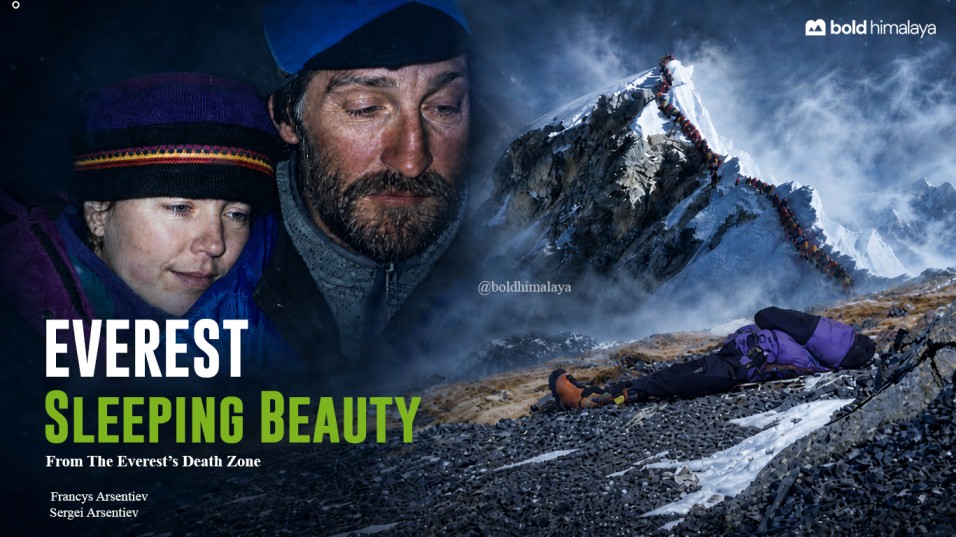
High above the clouds, at Mount Everest, where the ambitions of many have faced their toughest test, lies the story of Sleeping Beauty of Mount Everest, one of the most haunting stories ever told within the world of mountaineering. The title does not belong to one from an ancient tale or legend; rather, to a real climber whose final moments became part of Everest’s silent landscapes.
Amongst the several dead bodies on Mount Everest, she was one unique case. While others were left in a twisted, grotesque state, her peaceful look as though she had fallen asleep earned her the title of ‘Sleeping Beauty.’ It was only after some time that her story took root among the climbing community and reached legendary proportions.
Positioned along a commonly used summit route, near the edge of the Everest Death Zone, she became an unintentional landmark. Climbers ascending toward the peak often encounter this stark reminder of how unforgiving the mountain can be. At such extreme altitude, where oxygen is scarce, and survival itself is uncertain, even a brief pause can turn fatal.
Who was the Sleeping Beauty of Mount Everest?
The ‘Sleeping Beauty’ of Mount Everest is Francys Arsentiev, an experienced climber whose story has become one of the most haunting in high-altitude mountaineering.
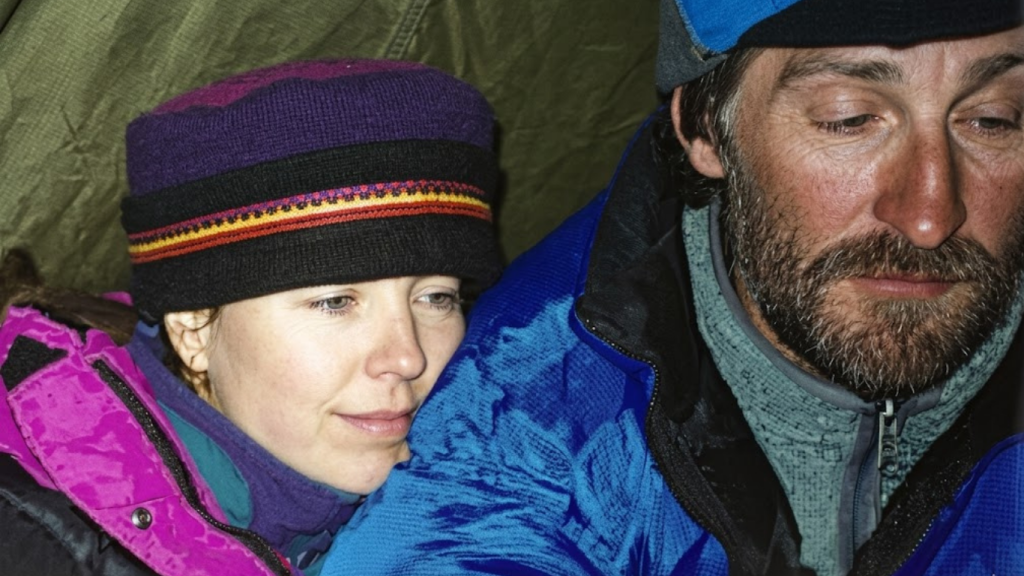
Francys Arsentiev (18 January 1958 – 24 May 1998) was the first American woman to ascend Mount Everest without supplemental oxygen on 22 May 1998. Her life is equally a testament to mountaineering expertise and a demonstration of humans’ nature to transcend, even in the face of the world’s worst weather.
She became ‘Sleeping Beauty’ because her rigor mortis corpse stiffened in the position of death frozen in the classic path to the peak, for nine years after she died, a gruesome preview of life on the violent summits of the mountain. Her story is as engrossing for climbers and adventurers everywhere, symbolizing the beauty and terror of men ascending high mountain peaks.
The story of Francys Arsentiev reminds us of the vast potential of mountain climbing and the risks of realizing our highest dreams. She is a source of inspiration and warning to aspiring climbers who are prepared to conquer the world’s tallest mountain.
Early Life and Background
Francys was born and brought up as a Hawaiian native in Honolulu, Hawaii. Born on 18th January 1958 to the world, which was subsequently privileged to witness her reach the world’s highest points, Francys mothered in tropical paradise, Hawaii. No one had the least inkling that this lady would ever muster the courage to climb the world’s highest point without oxygen.
Francys Arsentiev showed determination and ambition from an early age, qualities that later defined her life. Known for her strong will and intellectual curiosity, she developed a deep passion for mountaineering as an adult. Although not raised in a remote wilderness setting, her drive for challenge and exploration ultimately led her to pursue high-altitude climbing, culminating in her attempt on Mount Everest.
Family Life and Relationships
Francys married Sergei Arsentiev in 1992. Sergei was also an experienced Russian mountaineer. Their relationship was deeply rooted in a shared passion for high-altitude mountain climbing. The couple often climbed together, supporting each other in some of the world’s most challenging environments, including their final expedition on Mount Everest.
She also had a son, Paul Distefano, from her previous marriage. Paul Distefano was the other fixed point in her life. Domestic life was unconventional, with both parents being joint climbers at high altitudes, and Paul therefore had to put up with day-and-night ragging of his parents’ fatal climbing feats.
The Passion for Mountaineering
Francys was not a leisure climber who arrived at Everest midlife. She was a committed climber from the beginning, working on technical skills, physical training, and mental endurance of high-altitude climbing. Her passion was marked by determination and bold ambition. Francys pursued high-altitude peaks with a clear goal in mind: to push beyond limits and achieve something extraordinary.
Her relationship with Sergei gave her a climber who shared her passion and someone to help her reach her destination. They had only one thing that fueled their love and passion: mountaineering. Climbing without supplemental oxygen was risky, but they were ready to take the risk together because both desired to accomplish their dreams.
The Dream to Climb Everest Without Oxygen
Why Climb Without Supplemental Oxygen?
The greatest mountaineering feat is to climb Mount Everest without oxygen. Mount Everest ascent is one of the most dangerous mountains in the world to climb. Its fatality rate is roughly 6.5 fatalities for every 100 to try ascent, and ascent with no oxygen doubles the number.
She aspired to climb Mount Everest without supplemental oxygen in order to become the first American woman to achieve this feat. Her goal was not driven by ego, but by a determination to push boundaries and prove that women could compete at the highest levels of extreme mountaineering.
Climbing without oxygen at such an altitude demands exceptional physical fitness, mental resilience, and precise acclimatization. The human body is not naturally adapted to function above 8,000 meters, where oxygen levels drop to nearly one-third of those at sea level. In this environment, known as the Death Zone, many climbers suffer from altitude sickness, extreme exhaustion, and impaired judgment, making every step increasingly dangerous.
The Significance of the Achievement
And if she did, Francys would be part of an elite club of mountaineers that reached the summit without the aid of man-made oxygen. She would be among the elite of the climbers, demonstrating not only physical capabilities but determination and technical skills.
It would be the first for American women climbers. It would set the standard that women were worthy of competing with men on an equal basis under the worst conditions and challenge generations of women climbers to prove their acts of courage.
The Fateful 1998 Everest Expedition
- Journey to Base Camp
In May 1998, Francys and Sergei Arsentiev trekked to the Everest Base Camp. They had spent years planning for this day. The couple reached the base camp with high expectations and a resolve to make history.
The ascent to base camp is a strenuous, gradual process designed to help the body acclimatize to low oxygen levels. They ascended step by step through the higher camps, allowing their bodies to adjust progressively. In this case, they were ascending the north face of Mount Everest, located in Tibet.
- The Climbing Route
The team descended from the north face of Mount Everest after ascending from the Tibetan side. The route is highly technical and exposed, demanding strong climbing skills. As they made their way up through the North Ridge route, they realized they were reaching the summit far too late in the day, leaving them with no choice but to spend the night above 8,600 meters.
The North Ridge route exposes mountaineers to a sequence of increasingly higher and tougher terrain than they had encountered at their prior camps. The route features technical rock climbing, ridge exposure, and the part where the weather is likely to turn against them to create deadly hazards.
- Summit Success
Francys ascended on 22nd May 1998. She was the first American woman climber to ascend Everest without using supplemental oxygen. It was unbelievable. Finally, after years of exercise and toil, Francys realized her dream and became a part of history.
To climb Mount Everest without oxygen was an unthinkable career and personal goal. She had proved that American women were as capable as anyone at the mountaineering summit and were among the best climbers in the world.
But the summit is merely half of the battle. Downclimbing is perhaps even more dangerous than climbing, with the climbers fatigued, the weather potentially worsening, and high altitude still impairing skill and judgment.
The Tragic Descent
What Went Wrong?
Unfortunately, the descent proved fatal for Francys. During their descent, exhaustion, hypoxia (lack of oxygen), and freezing temperatures began to overwhelm them. At some point in the darkness and chaos, Francys and Sergei became separated, a critical moment that sealed their fate. Sergei managed to descend to camp but realized his wife was missing, so he turned back into the deadly altitude to search for her, carrying oxygen in a desperate rescue attempt.
On May 23, an Uzbek climbing team found Francys high on the mountain, barely conscious, suffering from severe oxygen deprivation and frostbite. She was unable to walk on her own. The team tried to help her, giving oxygen and attempting to move her down, but in the Death Zone, where even standing requires immense effort, they were eventually forced to leave her behind to save themselves.
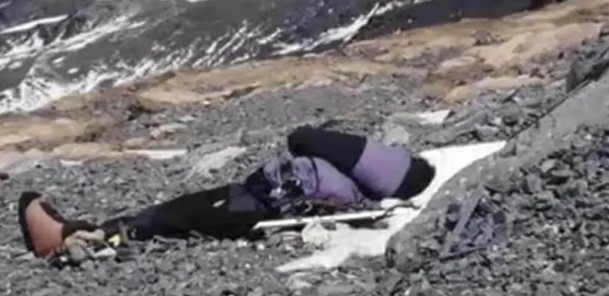
The following day, other climbers, including experienced mountaineers, encountered her again. She was still alive but critically weak, lying clipped to a rope on the mountainside. Despite efforts to assist her, the extreme altitude, lack of resources, and life-threatening conditions made a full rescue impossible. After hours of trying, they had no choice but to descend. Francys Arseniev died there on May 24, 1998.
Her husband Sergei also perished during his attempt to save her, likely after falling while climbing back up the mountain.
The Sleeping Beauty Legacy
Why the Nickname ‘Sleeping Beauty’?
The ‘Sleeping Beauty‘ of Mount Everest is the nickname climbers have given Francys Arsentiev. Francys Arsentiev was stuck on the standard route to the summit. How she acquired this nickname is the way her body remained peaceful and quiet, as though she slept in the snow. Despite the brutal conditions of the Everest Death Zone, her body appeared undisturbed by violence or dramatic injury.
She was the subject of hundreds of pictures of her enigmatic sleeping form in the next nine years. This fostered an otherworldly presence that would be one of the most mythical and controversial parts of Everest climbing history.
Impact on the Climbing Community
The sight of Francys’s body down the length of the ascent had a profound impact on climbing history. Climbers who made it up to her route faced the truth of the danger, the risk of mountain climbing, for nine years. Francys’s story was a bell ringer sounding out high-altitude climbing danger and the need for cautious planning and prudence.
The climbers stated that some of them were highly disturbed by seeing her body and that several of them freely admitted being starkly reminded of the reality of their mortality as well as of the gravitas of their attempt. Her body was located close to a commonly used summit path on the north side of Everest. This meant that climbers ascending and descending the mountain could not avoid passing near her. Unlike remote avalanche zones or hidden crevasses, her position was visible and exposed along the route, making her a silent landmark on one of the world’s most dangerous climbs.
The Removal of Her Body
Francys Arsentiev’s body was left exposed to climbers until 2007, when it was moved out of view. Her body movement was a flashy start to the history of Everest climbing because it took great effort and cost to move at such a high altitude.
In 2007, a small humanitarian effort led by experienced climbers carefully moved her body away from the main climbing route to a less visible location, both to reduce the emotional impact on other climbers and to give her a more respectful resting place.
Death Zone: Why bodies remain on Everest?
High on Mount Everest, above an altitude of 8,000 meters, lies a region known as the Death Zone, a place where the human body can no longer survive for long, no matter how strong or experienced the climber is.
Lack of oxygen: At this extreme height, oxygen levels drop to about one-third of what is available at sea level. Every breath delivers far less oxygen to the body, leading to severe exhaustion, confusion, and life-threatening conditions like hypoxia. Even simple movements become incredibly difficult, and the body begins to shut down slowly.
Extreme conditions preserve bodies: The Death Zone is not only oxygen-deprived but also brutally cold, with temperatures plunging far below freezing. Combined with strong winds and low humidity, these conditions act like a natural freezer. As a result, bodies do not decompose in the usual way. Instead, they remain preserved for years, sometimes decades, exactly where climbers fall.
Risk of body recovery: Recovering a body from this altitude is extremely dangerous and often more risky than summiting itself. It requires a team of climbers to carry heavy weights in an environment where even standing is a challenge. Many recovery attempts have led to further injuries or deaths. Because of this, most bodies are left on the mountain, becoming silent reminders of Everest’s dangers.
The Broader Context: Women in Extreme Mountaineering
- Breaking Barriers
Francys’s achievement as the first American woman to summit Everest without supplemental oxygen was a significant milestone for women’s involvement in extreme mountaineering. She showed that women could compete at the top level and achieve the impossible.
Her accomplishments and life put thousands of women on the path to pursuing their climbing ambitions and placed growing levels of focus on the possibility of women participating in high-altitude adventure. The fact that she managed to do it in a setting that was dominated for a long time by men adds another dimension of amazement to her feat.
- The Cost of Achievement
But her story also suggests the cost of going beyond human potential. Enthusiasm to be “first” or for some purpose sometimes yields outcomes that would not otherwise have been attempted.
Pressure to achieve record heights can push mountaineers past the safety margin, putting their own lives at risk and the lives of others. Francys’s life reminds us that experienced and well-trained climbers, too, can be victims of the circumstances with no chances of survival.
- Legacy for Future Generations
Although the disastrous outcome, Francys’s achievement set a standard forever for women climbers to pursue extreme climbing. Her legacy challenges women to set their lofty aspirations and reminds them to look for safety as well as proper planning.
The climb has gained experience that resulted in more advanced climbing safety procedures and taught other climbers the danger of climbing Everest without supplemental oxygen.
Other Famous Landmarks on Everest
While Francys Arsentiev is known as the ‘Sleeping Beauty’, she is not the only climber whose presence became a part of Everest’s story. Over time, a few locations on Mount Everest have gained recognition as informal landmarks due to the realities of high-altitude climbing.
Green Boots
One of the most well-known is Green Boots, believed to be the body of an Indian climber who died in 1996. This site is located in a small limestone cave along the Northeast Ridge Route and became a widely recognized reference point for climbers heading toward the summit. The bright green mountaineering boots made it easily identifiable, and for years, climbers would use them to gauge their progress and position on the route.
Other visible bodies (respectful perspective)
Several other climbers remain on Everest, often in less-publicized locations. These individuals are not attractions, but rather reminders of the risks involved. Most are left where they fell due to the extreme danger of recovery in the Death Zone. Over time, some have become known within the climbing community, though many are treated with quiet respect and rarely discussed in detail.
Why do they become route markers?
In the harsh and featureless terrain of the upper mountain, natural landmarks are limited. Snow, ice, and rock often look the same across long stretches, and weather conditions can reduce visibility to near zero. As a result, anything fixed and recognizable, such as a body or a piece of gear, can unintentionally serve as a reference point for navigation.
This reality reflects both the practical and emotional complexity of climbing Everest. While these landmarks may help guide climbers, they also carry powerful human stories. For readers exploring Everest-related content, this section also offers a natural opportunity to connect with topics like the Everest Death Zone, summit routes, and ethical questions surrounding high-altitude mountaineering.
Everest Death Statistics
Mount Everest has long been a symbol of human ambition, but it also carries a sobering record of fatalities that reflect the mountain’s extreme risks.
Total deaths on Everest
According to historical data, at least 340+ climbers have died attempting to summit or descend from Mount Everest since the early 1920s. Despite thousands of successful summits, Everest still records deaths almost every year, making it one of the deadliest mountains in the world.
Main causes of death
Most fatalities are linked to a combination of environmental and human factors:
- Altitude sickness (HACE/HAPE): lack of oxygen leads to brain or lung complications
- Falls: especially during descent when climbers are exhausted
- Avalanches & ice collapse: sudden and often unpredictable
- Extreme weather: storms, high winds, and freezing temperatures
- Exhaustion & hypoxia: especially in the Death Zone
Many deaths occur during descent, when climbers have already used most of their energy.
Comparison of Past vs Recent Years
| Period | Death Trend | Key Insight |
|---|---|---|
| 1950s–1990s | Higher death rate (4–5%) | Limited gear, less experience |
| 2000–2019 | 3-4 deaths/year average | Improved safety and guiding |
| 2019 | 11 deaths | Overcrowding and delays |
| 2023 | 17-18 deaths | One of the deadliest recent seasons |
| Recent years | Fluctuating but improving | Better forecasting, but risks remain |
Modern Everest Climbing and Safety Improvements
Lessons Applied
The sad destiny of Sergei and Francys has enabled greater security in Everest expeditions. Contemporary expeditions are assisted by improved weather forecasting, communication equipment, and security devices that might have altered their destiny.
Nowadays, mountain expeditions are more focused on protection, timing, and descent when the risk becomes imminent. Whatever they have realized by experience has helped them in saving lives in future ascents.
Technology and Safety
Technology has also enhanced the safety of climbers on Everest. Enhanced weather forecasting allows for enhanced planning, satellite communication equipment allows team members to communicate with one another, and advanced equipment more effectively protects the climber from harsh weather.
But there will never be a point where technology removes all risk, and man’s susceptibility to altitude, weather, and the inherent risks is continually at hand. The Francys and Sergei’s story is a testament to the fact that no matter the best technology and training, this kind of climbing will always present risks.
The Debate Over Supplemental Oxygen
The climb of Francys Arsentiev without oxygen on Mount Everest remains highly debated. Some see it as the purest form of mountaineering, testing human limits in the Death Zone. Others argue it increases risk, slowing climbers and putting both them and potential rescuers in danger. Her story highlights the ongoing question in climbing: how much risk is acceptable in the pursuit of achievement?
FAQs of the Sleeping Beauty of Mount Everest
1. Who is the Sleeping Beauty on Everest?
The ‘Sleeping Beauty’ refers to Francys Arsentiev, an American climber who died on Mount Everest in 1998 after summiting without supplemental oxygen.
2. Why is she called Sleeping Beauty?
She was given this name because her body appeared peaceful, almost as if she were asleep, despite being in the harsh conditions of the Death Zone.
3. What happened to Sleeping Beauty on Everest?
Francys Arsentiev successfully reached the summit but became exhausted and oxygen-deprived during descent. After being separated from her husband, she was unable to continue and died high on the mountain.
4. Is Sleeping Beauty still on Everest?
No, her body remained on Everest for years but was moved out of the main climbing route in 2007 during a humanitarian effort.
5. Was she the first woman to climb Everest without oxygen?
She was the first American woman to summit Everest without supplemental oxygen, making her achievement historically significant.
6. Where was Sleeping Beauty located on Everest?
Her body was located on the north side route, near the summit path in the Death Zone, where many climbers pass during ascent and descent.
7. Why are bodies left on Mount Everest?
Bodies are often left due to the extreme danger of recovery in high altitudes. The low oxygen, freezing temperatures, and difficult terrain make retrieval very risky.
8. How many dead bodies are on Everest?
It is estimated that over 200 bodies remain on Everest, many of which are hidden under snow, while some are visible along climbing routes.
9. What is the Death Zone on Everest?
The Death Zone refers to areas above 8,000 meters where oxygen levels are too low to sustain human life for long periods.
10. Can climbers avoid seeing bodies on Everest?
Not always. Some bodies lie near popular routes, making it difficult for climbers to completely avoid them during their journey.
Conclusion
The story of Francis Arsentiev, the “Sleeping Beauty of Mount Everest,” is the most tragic and saddest in mountaineering history. Her achievement as the first American woman to climb Everest without supplemental oxygen, the ultimate summit of human will and athletic ability, all provoking jealousy from those of lesser mettle, her untimely death an astringent reminder of the price of paying for high-risk climbing.
Up to now, Francys Arsentiev’s May 24, 1998, is one of the saddest events on Mount Everest. Her legend fascinates and encourages climbers all over the world, both as a benchmark of what is possible and as a warning example in the call for caution and restraint.
The legacy of Francys and Sergei Arsentiev seems beyond their achievement to speak more generally of risk, ambition, and value in human life, striving toward our highest aspiration. There is the reminder that standing behind every climbing figure are actual human lives with families, loved ones and aspirations, and that striving for ultimate attainment always will be fraught with ultimate risk.
Francys Arsentiev’s experience is a witness that safety, proper preparation, and reverence for the risk of the mountain are essential equipment for any successful ascent. Her victory and final sacrifice construct and teach climbers today, and she will thus be a legacy greater than the period her physical body was removed from the mountain.
Comments (0)
Write a comment- Who was the Sleeping Beauty of Mount Everest?
- The Dream to Climb Everest Without Oxygen
- The Fateful 1998 Everest Expedition
- The Tragic Descent
- The Sleeping Beauty Legacy
- Death Zone: Why bodies remain on Everest?
- The Broader Context: Women in Extreme Mountaineering
- Other Famous Landmarks on Everest
- Everest Death Statistics
- Modern Everest Climbing and Safety Improvements
- FAQs of the Sleeping Beauty of Mount Everest
- 1. Who is the Sleeping Beauty on Everest?
- 2. Why is she called Sleeping Beauty?
- 3. What happened to Sleeping Beauty on Everest?
- 4. Is Sleeping Beauty still on Everest?
- 5. Was she the first woman to climb Everest without oxygen?
- 6. Where was Sleeping Beauty located on Everest?
- 7. Why are bodies left on Mount Everest?
- 8. How many dead bodies are on Everest?
- 9. What is the Death Zone on Everest?
- 10. Can climbers avoid seeing bodies on Everest?
- Conclusion
Read the latest Blogs & Insights
Explore our collection of articles and insights to gain in-depth travel knowledge, expert advice, and stay updated on the latest trends and tips.
View All Articles
Broad Peak Avalanche: Nirmal Purja & the Team
10 Aug. 2026
Prayer Flags
10 Jul. 2026
Golf Tour in Nepal
24 Aug. 2026



No comments yet.