


Mount Everest Expedition | Climb the world’s highest mountain
Mt. Everest is the highest and the most magnificent mountain in the world. Towering 8,848m/29,029ft above sea level, Everest is located in the Mahalangur range between Nepal and Tibet. The south side of Mt. Everest lies in Nepal while the north side lies in Tibet.

-
 admin
admin
-
29 October, 2024
-
21 mins read
-
1863 Views
-
0 Comments


Every Mount Everest Expedition begins long before Base Camp, with a dream, years of preparation, and the quiet determination to stand where only a few humans ever will. It is a journey that tests the human spirit, resilience, and the courage to chase the ultimate dream.
The Mount Everest Expedition represents the greatest possible accomplishment in high-altitude mountaineering. Mount Everest is the world's highest mountain and is most magnificent. Towering 8,848.86 meters / 29,031.7 feet above sea level, Everest is also known as "Sagarmatha" in Nepal and "Chomolungma" in Tibet. It is located in Nepal's Khumbu region within the protected Sagarmatha National Park.
Climbing Everest involves much more than reaching the top. It requires extensive preparation, physical stamina, technical abilities for climbing, and proper acclimatization. Climbers must face dangers such as the Khumbu Icefall, high altitude, and weather conditions that are so severe. Climbing Everest includes all such phases.
As the highest peak in the Himalayas, Mount Everest has been a destination for adventure-seekers from all over the globe. For someone like you, planning an expedition to the top of such an iconic peak is an adventure in itself. Therefore, this guide to Mount Everest Expedition aims to provide all the information you need to know.
Where is Mount Everest Located?

Mount Everest, the world’s highest mountain at 8,848.86 meters / 29,031.7 feet, is located on the border between Nepal and Tibet (China). Mount Everest is situated in Nepal’s Khumbu region, part of the majestic Himalayan range, and lies within the protected Sagarmatha National Park, a UNESCO World Heritage Site known for its stunning landscapes, diverse flora and fauna, and Sherpa cultural heritage. Though shared by both countries, the most popular climbing routes start from the Nepalese side, which offers easier access, established trails, and expedition support.
The southern approach begins with a scenic flight to Lukla, followed by a trek through picturesque villages, terraced farmlands, and lush forests leading to Everest Base Camp, the starting point for most climbers attempting the summit. Nepal’s Khumbu side combines natural beauty, cultural richness, and well-developed infrastructure to attract adventure-seekers from across the global map.
Mount Everest Expedition History
The first climbers to officially reach the summit of Mount Everest in 1953 were Tenzing Norgay, a Nepali sherpa mountaineer, and Sir Edmund Hillary, a New Zealand explorer. Tenzing Norgay had already been up to higher than 8,000m, but it was Hillary’s first attempt at the mountain.
The first organized attempts to climb Everest began in the 1920s under British expeditions. Notable early climbers included George Mallory and Andrew “Sandy” Irvine, who famously disappeared near the summit during the 1924 expedition. Their fate remained unknown for decades, sparking one of mountaineering’s greatest mysteries: whether they reached the summit before their deaths.
1922 was the first time a human was reported to climb higher than 8000m. George Finch reached an elevation of 8,320m/27300ft, using oxygen for the first time. The next expedition, in 1924, was aborted by Mallory and Geoffrey Bruce. After that, Norton and Somervell traversed the North Face and managed to reach 8,850m/28,050ft without oxygen and in perfect weather. On 8 June 1924, George Mallory and Andrew Irvine attempted the summit via the North Col-North Ridge-Northeast Ridge route.
They never returned. Mallory’s body was found on the North Face in a snow basin below and west of the traditional site of Camp 4, by the Mallory and Irvine Research Expedition on 1 May 1999. Since then, the controversy has raged in the mountaineering community as to whether one or both of them reached the summit 29 years before the confirmed ascent and safe descent of Everest in 1953 by Norgay and Hillary.
In a ninth British expedition led by John Hunt, two climbing pairs were selected for a summit attempt. On 26 May 1953, the first pair, Tom Bourdillon and Charles Evans, came within 100m of the summit. But they turned back after running out of oxygen. Then, two days later, the second climbing pair of the expedition made its second assault on the summit. The second pair made the first-ever successful climb to the summit of Mount Everest: Tenzing Norgay and Sir Edmund Hillary. On 29 May 1953, via the South Col route, they reached the summit at 11:10 am local time.
After the first successful summit of Mount Everest, other ambitious record-setters have sought to make their mark in its history book. The first confirmed summit from Mount Everest’s North Side was by Tibetan Nawang Gombu and Chinese mountaineers Wang Fu-Zhou and Chu Yin-Hau on 25 May 1960. Japan’s Junko Tabei became the first woman to climb Everest in 1975. In 1978, Reinhold Messner and Peter Habeler became the first to reach the summit without supplemental oxygen.
Reinhold Messner also became the first solo climber to reach the summit in 1980. The first blind person to reach the summit was Erik Weihenmayer in 2001. There is also a record of the oldest person to reach the summit – Min Bahadur Sherchan, aged 76. At the age of just 13, Jordan Romero recorded his name as the youngest person to reach the summit. And in 2005, Mona Mulepati and Pem Dorja Sherpa, a Nepalese couple, were recorded as the first couple to get married atop Mount Everest.
Mount Everest Expedition Routes
Located on the border of two countries, Mount Everest is part of the magnificent Himalaya range. With this location, there are two main climbing routes available. One is the southeast ridge of Nepal, and the other the north ridge of Tibet.
The Southeast Ridge expedition from Nepal is the most popular and scenic. Mount Everest was first conquered from that ridge by the two legends, Tenzing Norgay and Sir Edmund Hillary. After their successful summit on 29th May 1953, the southeast ridge expedition gained popularity. To date, hundreds of climbers worldwide have successfully reached the summit of Mount Everest. The main climbing routes on the south and north sides of Everest vary greatly. Expedition through the south ridge to the summit is more direct and steep than that of the north side.
It makes summiting somewhat more challenging, yet a climber in distress can descend to safety much quicker on the south side. Additionally, helicopter evacuations are possible from Base Camp and Camp 1 above the Khumbu Icefall, which is not located on the north side.
North Ridge Route
The North Ridge Route from Tibet is a technically demanding path to the summit of Mount Everest. It has fewer climbers and is less crowded than the popular South Col Route, offering a more remote and challenging experience. However, this route requires additional logistics, including road access planning, permits from China, and careful coordination with support teams, making it suitable only for climbers with strong high-altitude experience and technical skills.
South Col Route
The South Col route expedition begins from the Base Camp on the south side of Mount Everest at 5,380m / 17,700 ft in Nepal. The expedition journey begins with a scenic flight from Kathmandu to Lukla, followed by a multi-day trek through the Khumbu region to reach Everest Base Camp (5,364 m).
Everest Base Camp is at an elevation of 5,380m/17,700ft. Trekking to the Base Camp allows proper altitude acclimatization to prevent altitude sickness. You will experience proper acclimatization and preparation before ascending to Base Camp 1 of Everest. During your stay at Base Camp, you will take a short hike and practice climbing with Sherpa guides using climbing gear. And after checking everyone’s health condition in the expedition party, the journey will continue.
Camp 1 at 6,065m/19,900ft
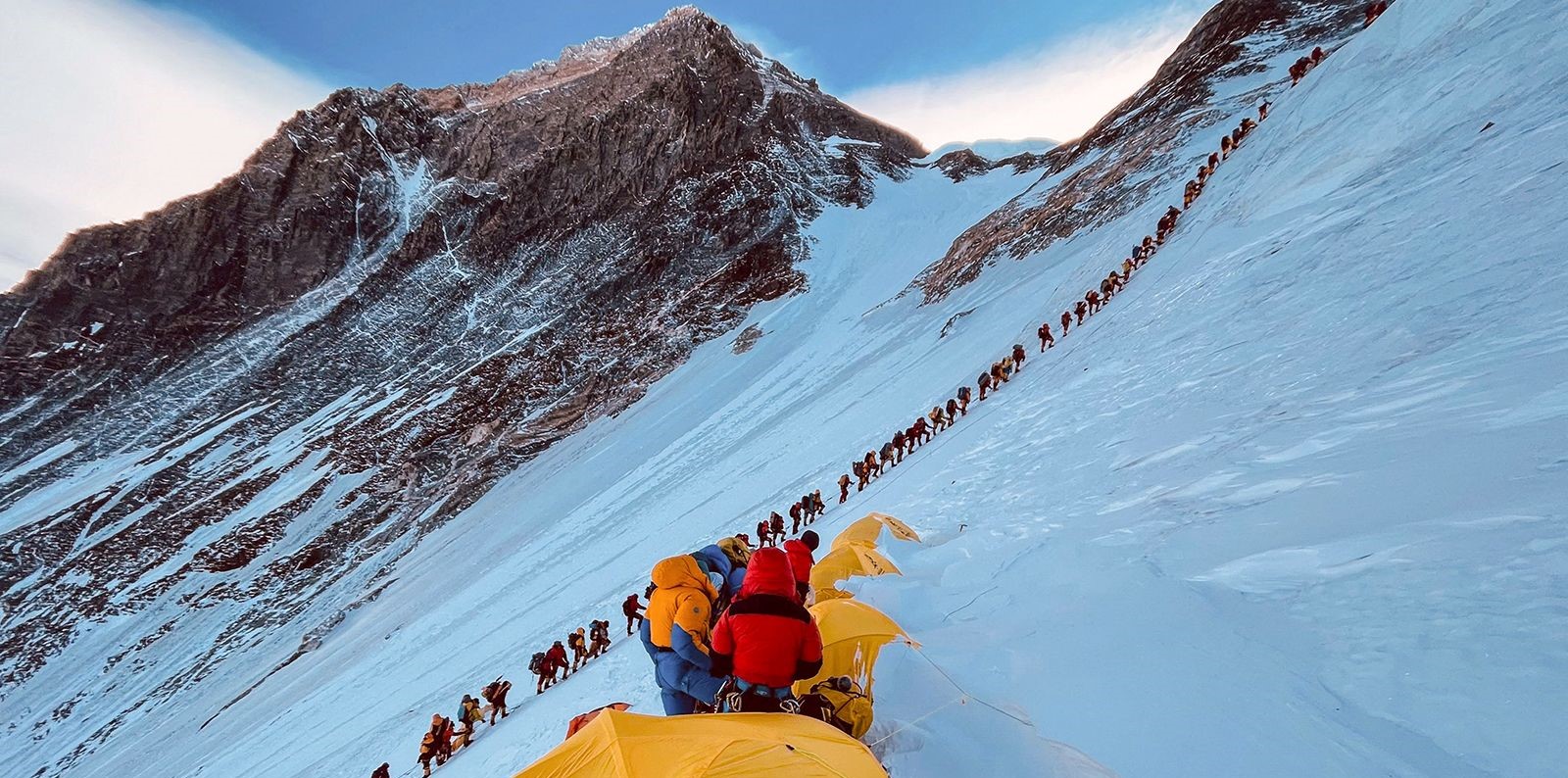
Behind Everest Base Camp, the route immediately enters a maze of crevasses, towering seracs, and shifting ice formations where some are the size of large as houses. Climbers navigate this section using fixed ropes and aluminum ladders to cross deep cracks and unstable terrain.
This area, known as the Khumbu Icefall, is one of the most dangerous parts of the entire Everest expedition. During the acclimatization period, highly skilled Sherpa teams work ahead of the climbers to install ropes and ladders, ensuring a safe passage through this constantly moving glacier.
After successfully clearing the Icefall, climbers reach Camp 1, set on a relatively flat, open expanse above the icefall.
Camp 2 or Advanced Base Camp (ABC) at 6,500m/21,300ft
After Camp 1, climbers continue their way up the “Western Cwm” to the base of the Lhotse face. The Western Cwm is also described as the “Valley of Silence”. The topography of the area frequently cuts off the wind from the climbing route.
The Western Cwm is a flat, lightly rising glacial valley, marked by immense lateral crevasses in the centre. It prevents direct access to the upper reaches of the Cwm. It is followed by a small passageway, known as the “Nuptse corner”. The high elevation and a clear, windless day can make the temperature at Western Cwm feel extremely warm for climbers.
Camp 3 at 7,470m/24,500ft
From Camp 2, climbers ascend the steep, icy wall of the Lhotse Face, one of the most technically demanding sections of the expedition. Lhotse is the 4th tallest peak in the world. Using fixed ropes, climbers slowly make their way up the hard blue ice and snow. Due to the steepness and exposure, this section typically operates with one-way traffic for safety.
Camp 3 is established on a small ledge carved into the Lhotse Face, offering a temporary but necessary resting position before moving into the Death Zone.
Camp 4 at 7,920m/26,000ft
Camp 4 is another 500m away from Camp 3. The Camp 3 to Camp 4 journey brings two additional challenges for climbers.
1. The Geneva Spur: It is also called Saddle Rib, and is a large rock buttress near the summits of Mount Everest and Lhotse.
2. The Yellow Band: The Yellow Band is a section of interlayered marble, phyllite, and semi-schist, which also requires about 100m of rope for crossing. Fixed ropes help climbers scramble over this snow-covered rock band. Most climbers begin using oxygen at this point.
Camp 4 marks the final resting point before the summit push. After Camp 4, you will be at the top of the highest mountain in the world. One step further and your dream will come true.
Summit of Mount Everest - 8,848m/29,029ft
Ascend another thousand meters, and you will be atop the summit. With hopes of reaching the summit within 10 to 12 hours, climbers begin their summit push around midnight. This is the day climbers enter the “death zone”, the elevation over 8,000m, where the oxygen pressure is insufficient for human life for an extended time.
After that, climbers reach “the balcony” at an elevation of 8,400m/27,600ft. It is a small platform where climbers can rest and gaze at peaks to the south and east in the early light of dawn.
After the Balcony, climbers then encounter a series of rocky stairs with steep steps that often involve deep snow, making the risk for an avalanche a reality. This leads to the South Summit (8,750 m / 28,700 ft), a small ice dome that signals the beginning of the exposed Cornice Traverse, a narrow ridgeline with cliffs dropping thousands of meters on both sides.
Carefully following fixed ropes, climbers move across fragile cornices toward Hillary Step, a 12-meter rock wall first climbed by Hillary and Tenzing. After ascending this final major obstacle, they continue over a short stretch of loose rock and fixed ropes before reaching the easier, moderate snow slopes that lead straight to the summit of Mount Everest.
Finally, you are at the top of Mount Everest, surrounded by the greatest mountains in the world. The feeling of a successful summit of Mount Everest is beyond imagination. The summit is capped by snow above ice over rock, and the layer of snow modifies from year to year. The top of Mount Everest has been described as the “size of a dining room table” by successful climbers.
Best time for the Mount Everest Expedition
Mountain Climbing in Nepal is a seasonal activity. Not every season is suitable for mountain or peak climbing, especially for the Mount Everest Expedition. Autumn and Spring are the best seasons for most mountain expeditions in Nepal.
April to May and mid-June to August are the best times for climbing Mount Everest. Throughout this period, it has the most stable weather, longer daylight hours, and lower wind speeds. The days will be sunny and warm in the Himalayas. Besides that, the skies will be clear, and the atmosphere of the Himalayas will be alluring during these seasons.
Most climbers reach the top during the short and predictable May summit window, when the jet stream shifts away from the mountain, creating calmer conditions. Expeditions during this season offer great views of the mountains.
Duration of the Mount Everest Expedition
The Mount Everest Expedition typically takes 55 to 65 days, allowing climbers enough time for gradual acclimatization and preparation at high altitudes. It is much more difficult and treacherous than simply trekking to Everest Base Camp.
The journey includes several rotations between Base Camp, Camp I, Camp II, and Camp III to help the body adjust to thinning air. After weeks of careful planning and weather monitoring, the final summit push is made during a short and stable weather window in May, when winds are calmer and conditions are safer.
Difficulty and Challenges of Climbing Mount Everest
Climbing Mount Everest represents one of the most demanding tasks that exists in the world of mountaineering. It requires perfect physical fitness, great mental strength, and technical preparation. Several factors make this expedition extremely difficult.
1. Extreme Altitude: At the summit (8,848.86 m / 29,032 ft), the oxygen level is only about 33% of what is available at sea level, making breathing extremely difficult and increasing the risk of hypoxia. Most climbers use supplemental oxygen to improve safety and summit success.
2. Khumbu Icefall Hazards: On the South Col Route, climbers must navigate the treacherous Khumbu Icefall, a constantly shifting glacier filled with deep crevasses, towering seracs, and unstable ice. This section is considered one of the deadliest parts of the expedition.
3. Extreme Weather & Frostbite Risk: Climbers face harsh temperatures, high winds, and sudden storms. Frostbite, hypothermia, and wind chill can be life-threatening, particularly in exposed areas like the South Col or North Ridge. Avalanches are also a persistent danger.
4. Death Zone Exposure: Any elevation above 8,000 meters is known as the Death Zone, where the body cannot acclimatize. Prolonged exposure leads to extreme fatigue, impaired judgment, and potentially fatal altitude sickness.
Successfully climbing Mount Everest requires careful planning, rigorous training, and constant attention to weather and safety protocols. Despite these challenges, climbers who prepare well and respect the mountain can safely achieve this incredible feat.
Physical Fitness and Experience Required for Mount Everest Expedition
Climbing Mount Everest is one of the most physically and mentally demanding challenges on Earth. It not only needs determination, but it also needs experience, fitness, skill, and mental toughness. Some of the essential skills needed before climbing Mount Everest include:
1. High-Altitude Experience: Climbers should have previously summited peaks of 7,000 meters before getting an Everest permit. This experience helps the body adapt to thin air and teaches climbers how to manage the risk of altitude sickness during the Mount Everest expedition.
2. Technical Mountaineering Skills: Experience in ice climbing, snow travel, rope handling, and glacier travel skills is a must. Climbers should be competent in the use of crampons, ice axes, ascenders, fixed ropes, and ladders while crossing crevasses, icefalls, or steep slopes.
3. Cardiovascular & Muscular Endurance: The expedition involves long days of climbing at extreme altitudes. Climbers must have excellent stamina, strong legs, core strength, and aerobic fitness to sustain energy over weeks of strenuous activity.
4. Mental Resilience & Decision-Making: Everest is as much a psychological challenge as a physical one. Climbers must stay calm under stress, think clearly under fatigue, and remain patient in dangerous conditions, especially in the Death Zone above 8,000 meters.
5. Health & Injury Preparedness: A thorough medical checkup is necessary before the expedition. Climbers should have no serious heart, lung, or respiratory conditions and should be able to endure extreme cold, low oxygen, and physical strain for extended periods.
6. Teamwork & Expedition Awareness: Climbing Everest requires collaboration with Sherpas and fellow climbers. Understanding group dynamics, following expedition protocols, and respecting the mountain are critical for safety and success.
Cost of Mount Everest expedition
Climbing Mount Everest is a major financial commitment as well as a physical and mental challenge. The total cost can vary widely depending on the level of service, duration, and inclusions. The costs are between $35,000 and $45,000. This range can increase based on your chosen facilities, but this cost is the minimum you will expect to pay. There are still some fixed costs that every climber has to pay. Many factors contribute to this price. Based on the facilities, the prices are:
- Basic / Local‑Led Expedition: $35,000 - $45,000 per person
- Mid‑Range Expedition Packages: $50,000 - $70,000 per person
- Western‑Guided or Premium Support: $75,000 - $85,000+
- Luxury or Full‑Support Expeditions: $100,000 - $130,000+
This cost includes:
1. Government Permits: The Mount Everest climbing permit from the Nepal side now costs USD 15,000 per person for the peak spring season (March-May). Off‑season permits (autumn or winter) are lower but rarely used due to harsher conditions.
2. Sherpa Guides and Expedition Leaders: Experienced Sherpas and professional leaders are essential for safety, route fixing, and high-altitude decision making. Their wages, insurance, and support logistics form a large portion of the expedition cost.
3. Supplemental Oxygen & Equipment: Climbers usually use 6-8 oxygen bottles with regulators and masks, which can add several thousand dollars to the budget, depending on quality and supply logistics.
4. Base Camp Food & Logistics: This includes meals, accommodations, yaks/porters or helicopter loads for cargo, communications equipment, satellite phones, and ground transportation.
5. Rope Fixing and Safety Equipment: Rope fixing teams, ice screws, harnesses, anchors, and other hardware are crucial for safety in dynamic sections like the Khumbu Icefall and upper ice faces.
Note: Everest climbing is challenging and technical. Climbers need proper climbing gear for a successful expedition. You should bring your own climbing gear; however, Bold Himalaya can outfit you with climbing gear for an additional cost.
Permits and Documents Required for Mount Everest Expedition
Mount Everest Expedition requires several official permits and documents to ensure safety, legal compliance, and support logistics. These permits are mandatory for all climbers, and fees are set by the Government of Nepal.
1. Mount Everest Climbing Permit (Nepal): This is the primary permit required to ascend Mount Everest from the south side. The cost for the spring climbing season (March-May) is USD 15,000 per person, with lower rates in off-season months. The permit regulates the number of climbers and ensures that expeditions follow safety and environmental guidelines.
2. Sagarmatha National Park Entry Permit: Since Mount Everest lies within Sagarmatha National Park (UNESCO World Heritage Site), all trekkers and climbers must purchase this permit. It covers park conservation and allows access to the trails and base camp areas.
3. Khumbu Pasang Lhamu Rural Municipality Entrance Permit: This permit is required to enter the Everest region. The local government of Khumbu directly collects USD $20-$25 per person. For your information, this is a new permit imposed from 1st of October 2018, replacing an existing TIMS Card. You can obtain this permit from both Lukla and Monjo.
Along with permits, there are several other documents required for the Mount Everest Expedition. Additional documents may include passport copies, medical certificates, travel insurance with high-altitude coverage, and expedition agreements with registered operators. Ensuring all permits and paperwork are in order is essential before embarking on the climb, as officials strictly enforce these regulations.
Accommodation During the Mount Everest Expedition
Accommodation on a Mount Everest Expedition varies as climbers move from the lower Khumbu Valley to the high-altitude camps on the mountain. During the trek to Everest Base Camp, climbers stay in local tea houses, which offer basic but comfortable rooms, warm meals, and a communal atmosphere ideal for acclimatization.
Once at Everest Base Camp, the team settles into fully equipped expedition tents, including dining tents, communication tents, kitchen facilities, and personal sleeping tents designed to withstand harsh Himalayan conditions.
Above Base Camp, accommodation becomes more rugged and functional. Climbers sleep in high-altitude mountain tents set up at Camp 1, Camp 2, Camp 3, and Camp 4. These shelters provide essential protection from extreme cold, strong winds, and low oxygen levels. Though minimal, they are built for survival and efficiency, with resting, hydration, and preparing for the next stage of the ascent in mind.
Safety Measures and Rescue Options
Safety is the highest priority during the Mount Everest Expedition, and multiple systems are in place to protect climbers throughout the journey.
Highly Experienced Sherpa Support: One of the biggest advantages is the support of highly experienced Sherpa guides, who manage rope fixing, navigation, load carrying, and support during dangerous sections like the Khumbu Icefall and high camps.
Accurate Weather Forecasting Systems: Teams rely on professional meteorologists and real-time forecasts to choose safe acclimatization days and the best summit window.
Helicopter Rescue (Below Camp 2): Emergency helicopter evacuation is available from Base Camp and Camp 2, which allows quick medical response if needed.
Emergency Oxygen & First-Aid Kits: Supplemental oxygen, medical supplies, and communication devices (sat phones, radios) are carried for altitude sickness, injuries, or sudden health issues.
Strict Acclimatization Schedule: Rotational climbs and daily health checks help prevent AMS, HAPE, and HACE during the expedition.
Why Choose a Professional Everest Expedition Operator?
A professional mount Everest expedition operator is essential for a safe, well-organized, and successful climb. A reputable company provides the structure, expertise, and support needed to navigate one of the world’s most challenging mountains. A professional operator ensures:
Certified guides & Sherpas: Experienced, government-licensed guides and Sherpas who understand the mountain, route conditions, acclimatization schedules, and emergency procedures enhance both safety and summit success rates.
Risk management & logistics planning: A dedicated team handles all behind-the-scenes coordination, including permits, transportation, gear management, route planning, weather monitoring, and acclimatization strategy. This ensures the entire expedition runs smoothly.
Safety protocols & emergency response: Professional operators follow strict safety standards, maintain high-quality equipment, provide communication devices, and prepare detailed evacuation plans. In the event of altitude issues, injuries, or unexpected weather, they are ready with an immediate emergency response.
FAQs of Mount Everest Expedition
1. How long does the Mount Everest Expedition take?
A full Mount Everest Expedition typically takes 55-65 days, including acclimatization, rotations, and the summit push during the weather window.
2. How difficult is it to climb Mount Everest?
Everest is considered extremely difficult due to high altitude, unpredictable weather, technical sections (Khumbu Icefall, Lhotse Face), and prolonged exposure in the Death Zone above 8,000 meters.
3. Do I need prior mountaineering experience to climb Mount Everest?
Yes. Climbers must have previous experience on 7,000 m peaks, high-altitude training, ice/snow climbing skills, and excellent physical conditioning.
4. How much does it cost to climb Mount Everest?
The cost ranges from USD 35,000 to 70,000+, depending on services, logistics, Sherpa support, oxygen supply, and expedition style.
5. What permits are required for the Mount Everest Expedition?
Permits required for the Mount Everest Expedition:
- Mount Everest climbing permit
- Sagarmatha National Park Entry Permit
- Khumbu Pasang Lhamu Rural Municipality Entrance Permit
6. What are the best months to climb Mount Everest?
The best time is Spring (April-May), which offers stable weather and the highest summit success rate.
Autumn climbs are rare and more challenging.
7. How cold is it on Mount Everest?
Temperatures can drop to –60°C at the summit, especially during nighttime and summit pushes.
8. How dangerous is Mount Everest?
Mount Everest is dangerous due to avalanches, crevasses, altitude sickness, frostbite, and harsh weather. Climbing with trained Sherpas and a professional operator significantly improves safety.
9. How long can climbers stay at the summit?
Most climbers stay only 10-20 minutes, depending on weather and oxygen levels.
10. How many people successfully climb Everest each year?
Approximately 600-800 climbers attempt the summit annually, depending on permits and weather conditions.
11. Do climbers use supplemental oxygen?
Yes. Most climbers use supplemental oxygen above 7,000 m. Each climber typically carries 4-7 oxygen cylinders.
12. What physical fitness is required?
Climbers should have:
- Strong cardiovascular fitness
- High-altitude experience
- Strength/endurance conditioning
- Technical ice and rock climbing skills
13. What accommodation is available during the Mount Everest expedition?
- Tea houses during the trek to Base Camp
- Fully equipped expedition tents at Base Camp
- High-altitude camps (Camp 1-4)
14. Is a helicopter rescue available on Everest?
Helicopter rescue is available up to Camp 2. Above Camp 2, rescue depends on Sherpa support and weather conditions.
Comments (0)
Write a comment- Where is Mount Everest Located?
- Mount Everest Expedition History
- Mount Everest Expedition Routes
- North Ridge Route
- South Col Route
- Best time for the Mount Everest Expedition
- Duration of the Mount Everest Expedition
- Difficulty and Challenges of Climbing Mount Everest
- Physical Fitness and Experience Required for Mount Everest Expedition
- Cost of Mount Everest expedition
- Permits and Documents Required for Mount Everest Expedition
- Accommodation During the Mount Everest Expedition
- Safety Measures and Rescue Options
- Why Choose a Professional Everest Expedition Operator?
- FAQs of Mount Everest Expedition
- 1. How long does the Mount Everest Expedition take?
- 2. How difficult is it to climb Mount Everest?
- 3. Do I need prior mountaineering experience to climb Mount Everest?
- 4. How much does it cost to climb Mount Everest?
- 5. What permits are required for the Mount Everest Expedition?
- 6. What are the best months to climb Mount Everest?
- 7. How cold is it on Mount Everest?
- 8. How dangerous is Mount Everest?
- 9. How long can climbers stay at the summit?
- 10. How many people successfully climb Everest each year?
- 11. Do climbers use supplemental oxygen?
- 12. What physical fitness is required?
- 13. What accommodation is available during the Mount Everest expedition?
- 14. Is a helicopter rescue available on Everest?
Read the latest Blogs & Insights
Explore our collection of articles and insights to gain in-depth travel knowledge, expert advice, and stay updated on the latest trends and tips.


No comments yet.