



Sky Burial Ritual: Why Tibetans Offer Bodies to the Sky
-
 Bold Himalaya
 -
28 May, 2026
-
13 mins read
-
677 Views
-
0 Comments


On the high Tibetan Plateau, where the air is thin and the ground is hard, burial traditions are different. One of the most unusual funeral rituals in the world, Sky Burial is a deeply spiritual practice that challenges modern ideas about death and burial. Instead of being buried in the ground or cremated, the body is offered back to nature, carried away by vultures in the high mountains of the Himalayas.
Sky Burial refers to an ancient funerary tradition practiced mainly in Tibet and parts of the Himalayan region, where death is seen not as an end, but as a transformation. In this ritual, the body is given to nature and scavenging birds, symbolizing the cycle of life, impermanence, and generosity.
Today, Sky Burial in Tibet continues to fascinate travelers, researchers, and spiritual seekers alike, not only because of its striking visual imagery but also because of the profound philosophy behind it. It reflects a worldview where life, death, and nature are deeply interconnected. By offering it to vultures, believers express compassion, detachment, and harmony with the natural world.
What is Sky Burial?
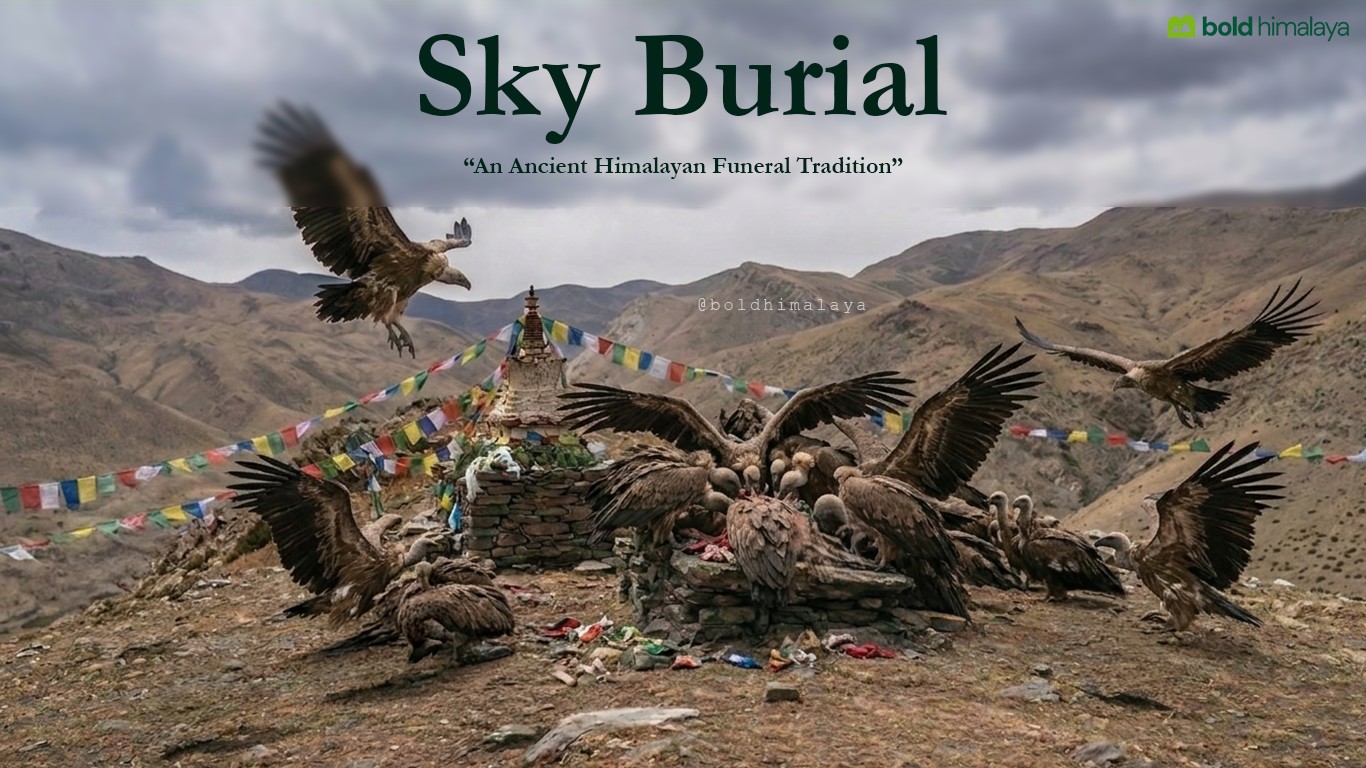
Sky burial is an ancient funeral practice in which a human body is returned to nature after death. Instead of burial or cremation, the body is placed in a high outdoor location where vultures and other scavenging birds consume it. This ritual is also known as Jhator, meaning “giving alms to the birds“. This practice is sometimes called ‘celestial burial’ because it reflects the belief that the spirit has already moved on after death. In this tradition, the body is seen as an empty shell once life has ended.
The practice is most closely linked with Tibetan Buddhism and is mainly found in Tibet, as well as remote Himalayan regions of Nepal, Mongolia, Bhutan, and parts of India. In these areas, rocky ground, high altitude, and limited wood for cremation helped shape this tradition over centuries.
The core belief behind sky burial is that the body becomes an empty vessel after death. By offering it back to nature, followers express compassion, generosity, and acceptance of the cycle of life and death. In Tibetan Buddhist belief, this act also reflects impermanence and the connection between humans and the natural world.
History and Origin of Sky Burial
Exactly how sky burial began in Tibet continues to invite debate among researchers. One view holds that it existed well before the past millennium; documentation grows stronger beginning in the 1100s, by which time Vajrayana Buddhist traditions were already shaping daily life across the region. Vajrayana Buddhism, a branch of Tibetan Buddhism that teaches impermanence and detachment from the physical body. Followers believe that after death, the soul has already moved on, leaving the body as an empty vessel. Returning it to nature is therefore seen as a final act of compassion and generosity.
Practical conditions also played an important role in shaping the ritual. Much of Tibet’s landscape is rocky and frozen, making ground burial difficult. At the same time, wood was scarce in many high-altitude areas, which made cremation expensive and impractical. As a result, local communities developed a funeral practice that worked in harmony with the environment.
For generations, monks and local villagers have followed this tradition as part of their culture and beliefs. Certain mountain sites became known as sacred places for the ritual. Specially trained people called rogyapas, or “body handlers,” prepare the body and carry out the ceremony with care and respect. Large Himalayan vultures, especially the Gyps himalayensis, play an important role in the practice. Over time, these birds became one of the most recognized symbols of sky burial.
Over centuries, sky burial became deeply rooted in Tibetan culture and religious life. Monks, spiritual leaders, and trained ritual specialists helped preserve the tradition, passing its customs and meanings from one generation to the next. Today, although modern changes have reduced the practice in some areas, sky burial remains an important spiritual tradition in remote Himalayan communities.
Spiritual and Religious Belief
In Tibetan Buddhist belief, dying marks a shift rather than a close. What follows is outlined in texts like the Bardo Thodol – known as the Tibetan Book of the Dead, which maps awareness after death and before return. Chanting by monastic practitioners occurs throughout this interval, their voices part of ceremonial acts meant to assist the drifting mind.
Sky burial aligns with several foundational Buddhist principles:
- What passes cannot stay. Even though the body once had a shape, it keeps changing after death and does not stay the same. In this view, trying to hold on to the body after life has ended goes against an important teaching. That teaching says everything is temporary, and nothing remains fixed forever. Giving the body back when breath has gone shows letting go.
- Kindness (karuna) involves offering food to creatures that are alive. Though the body no longer serves the one who once lived, it gives sustenance. From this last giving, spiritual value arises. For what comes after death, such an act carries quite weight.
- In Tibetan belief, all living beings are connected and not truly separate. Vultures are seen as part of a sacred process of return. Life is understood as one continuous cycle, and the idea of separation is seen as something created by human thinking rather than reality.
Among Tibetan households, sky burial does not come from hesitation. Instead, it is accepted as the fitting spiritual closing for someone common. In comparison, burning the body usually belongs to revered teachers and recognized incarnations.
How does the Ritual Happen?
The sky burial process follows a series of spiritual rituals and traditional practices that have been passed down for generations. While details may differ between regions, the main steps remain similar across Tibetan Buddhist communities.
Preparation After Death
After a person dies, the body is carefully wrapped in cloth and kept at home for 3 or 5 days. During this time, monks perform prayers and chant sacred texts, often for several days. These rituals are believed to guide the soul peacefully into its next journey. Family members may also light incense, offer butter lamps, and invite monks to conduct religious ceremonies before the burial takes place.
Transportation to the Burial Site
Once the prayers are complete, the body is carried to a remote mountain location or a special sky burial ground. These places are usually found on hillsides or high rocky areas away from villages. The journey is done quietly and respectfully, following local customs and spiritual traditions.
Ritual Preparation
At the burial site, Rogyapas prepares the body with great care. Juniper incense is burned, and the rising smoke is believed to attract vultures, which are connected to dakinis in Vajrayana Buddhism. The vultures often arrive quickly in large numbers, and their presence is seen as a positive and meaningful sign rather than something to be feared.
Return to Nature
After the offering is prepared, vultures quickly gather around the site. Bones are broken into small pieces with stones and mixed with barley flour, tea, and butter to form a soft mixture. The vultures then carry the remains away into the sky. When nothing is left behind, the ritual is considered complete.
During the ceremony, monks continue chanting prayers. In some places, family members may attend, while in others they do not. Rather than focusing only on grief, the ritual is viewed as a final act of compassion and respect for the person who has passed away.
Sky Burial Practices across Tibet and the Himalayan regions
Although sky burial is most commonly linked with Tibet, similar traditions are also practiced in some Himalayan and Central Asian regions, including Bhutan, Mongolia, and parts of western China. Each community follows the ritual in its own way, shaped by local culture and beliefs.
Even within Tibet, the practice differs from place to place. In some areas, the ceremony is highly detailed and carried out by trained rogyapas, whose roles are passed down through generations. In other regions, the ritual is simpler and more limited.
The involvement of monks and the size of the ceremony can also vary with the family’s financial situation and the social status of the deceased person. These differences developed naturally over time through local traditions and community customs.
Among highland regions of Nepal, such as Mustang and Dolpo, sky burial remains practiced – alongside cremation and interment. Families usually choose the funeral method based on tradition, personal belief, and guidance from Buddhist lamas or spiritual teachers.
Even as modern life reaches these remote areas, many old customs continue because of the unique mountain environment and strong cultural roots. There is no single rule that everyone follows. Some families choose cremation, while others continue the tradition of sky burial, where vultures help return the body to nature. These choices are often shaped more by family history, local customs, and practical conditions than by strict religious laws.
Modern Views on Ethics
Under Chinese rule since 1950, Tibet saw sky burial banned at one point. During the Cultural Revolution, officials stopped the rite altogether. By the 1980s, permission came back slowly. Sky burial still exists in some places, but it is now closely protected and done only under strict conditions. It is considered a private family and religious ritual, not something for public viewing.
There is often tension when outsiders try to see or treat it like a tourist attraction. Local Tibetan communities strongly say that sky burials should not be photographed or turned into a spectacle. Permission is rarely given, and in most cases, visitors are not allowed to attend. At the same time, the tradition is slowly changing. In cities and modern areas of Tibet, more people are choosing cremation or other funeral methods. Qualified rogyapas are harder to find in some areas.
Another concern is the decline of vultures, which are important for the ritual. Changes in the environment and the use of certain animal medicines in nearby regions have reduced their population, affecting the natural process. Because of all these changes, sky burial is becoming less common and more carefully managed than before.
Controversies and Misunderstandings
Sky burial is often misunderstood, especially outside the Himalayan region. It is worth noting that Western media coverage occasionally frames sky burial with surprise or fascination. This perspective shifts the focus away from its true significance, which can create misinterpretation. As a result, respect for the practitioners is often overlooked in such portrayals. Certain points, therefore, require a clearer understanding, perhaps more than others.
Another major issue is tourism. Some visitors are curious about sky burials and try to witness them as an attraction. This creates ethical concerns because the ritual is private, religious, and deeply personal for families. Turning it into a spectacle is considered disrespectful in Tibetan culture.
Far from being crude or a last resort, sky burial reveals deep thought about the end of life. It is rooted in ancient understanding and connects the body, decay, and earth in a quiet harmony. Rather than hiding what happens after death, it accepts it openly, without decoration or denial. Long before modern funeral practices were formed, this tradition already carried deep meaning. Vultures have a different meaning in Tibetan beliefs compared to Western interpretations. Their presence represents not loss, but transition, shaped by the vast sky and stillness of the mountains.
Media representation has also contributed to misunderstandings. Films, photos, and online content sometimes focus only on the unusual appearance of the practice, ignoring its religious and cultural importance. This can create a distorted or incomplete picture.
Because of this, cultural respect is very important. Sky burial is not meant for entertainment or curiosity viewing. It is a sacred rite that should be understood with sensitivity, respect, and awareness of the beliefs behind it.
Sky Burial vs Other Funeral Practices
Funeral practices vary across cultures, and sky burial is one of the most unique among them. When compared with burial and cremation, the differences are both environmental and cultural.
Traditional burial involves placing the body in the ground. It is widely practiced around the world and often requires suitable soil, land space, and coffins. In contrast, cremation uses fire to reduce the body to ashes and usually depends on access to fuel or modern cremation facilities.
Sky burial, however, follows a completely different approach. Instead of preserving or burning the body, it returns it directly to nature by allowing vultures and other birds to consume it. This method was developed in high-altitude Himalayan regions where burial is difficult, and wood for cremation is limited.
From an environmental perspective, sky burial leaves almost no physical waste and uses natural processes, while burial and cremation both require land, wood, or energy resources.
FAQs of Sky Burial
How old is the Sky Burial Tradition?
Over many centuries, this practice slowly developed. By around the 1100s, it became more clearly established within Tibetan Buddhist traditions. Although early forms existed much earlier, the ritual took shape gradually over time. Its formal recognition grew later as cultural and religious conditions in the region developed.
Is Sky Burial Legal in Nepal and Tibet?
Yes, sky burial is legal in both Nepal and Tibet. In Tibet (China), it is regulated and practiced in specific traditional areas under cultural and local guidelines. In Nepal, it is also legal and still practiced in remote Himalayan regions like Mustang and Dolpo, but it is limited to certain communities and depends on local customs and religious permission.
Why are vultures important in Sky Burial?
Among high peaks, vultures are seen as part of spiritual beliefs, including ideas connected to the Dakini realm. They are not viewed as ordinary scavengers, but as having an important role in the ritual. When they consume the body, it is understood as a way of returning it to nature. This act reflects a deeper belief in letting go and release after death.
Do vultures really eat the whole body?
Yes, vultures and other scavenger birds consume most of the soft tissue of the body. In some traditions, any remaining bones may be crushed and left for birds again. However, the exact process can vary depending on location and local practice.
Today, does sky burial continue to be observed?
Across Tibet, certain areas of Nepal, Bhutan, and Mongolia still observe sky burial. For numerous Tibetan Buddhist groups, this practice stands as the chosen means of handling death.
Can Tourists witness a Sky Burial?
Most of the time, people are not allowed to attend sky burials. It is a private and spiritual ritual that is carried out in seclusion. Entering without family permission or without understanding the culture can be seen as disrespectful. Taking photographs is also strictly forbidden in all known locations.
Is sky burial painful or disrespectful?
No, sky burial is not considered painful or disrespectful within the cultures that practice it. It is a sacred ritual based on Buddhist beliefs of impermanence and returning the body to nature. In these traditions, it is seen as a final act of generosity rather than harm or disrespect.
Comments (0)
Write a commentRead the latest Blogs & Insights
Explore our collection of articles and insights to gain in-depth travel knowledge, expert advice, and stay updated on the latest trends and tips.
View All Articles
Broad Peak Avalanche: Nirmal Purja & the Team
10 Aug. 2026
Prayer Flags
10 Jul. 2026
Golf Tour in Nepal
24 Aug. 2026



No comments yet.